
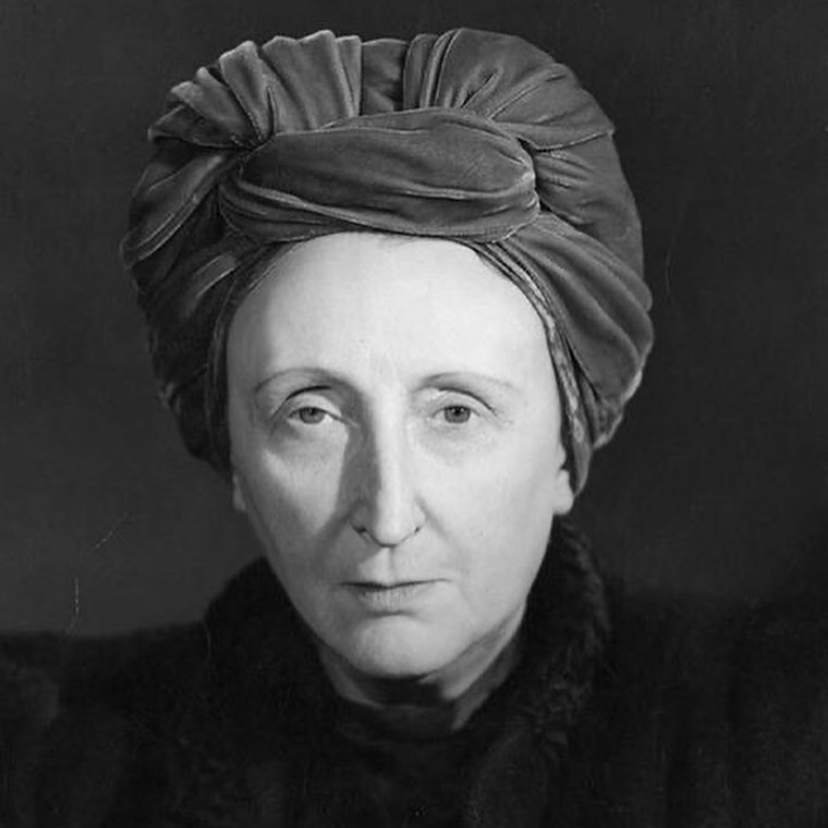
English aristocrat and writer Edith Sitwell was BOTD in 1887. Born at her family’s ancestral home in Scarborough, Yorkshire to an aristocratic family, she had an unhappy childhood, involving many years of painful (and unsuccessful) treatment for a spinal deformation, including being locked in an iron frame. Undeterred, she moved to London in 1914, sharing a flat with her childhood governess Helen Rootham and began writing and publishing poetry, often in collaboration with her (gay) brothers Osbert and Sacheverell. Famous for her height (she was six feet tall) and eccentric dress sense, she befriended most of the leading literary figures of her time, including Ottoline Morrell, Virginia Woolf, W. B. Yates, T. S. Eliot, Evelyn Waugh, Anthony Powell and Dylan Thomas, while maintaining lifelong feuds with writer Noël Coward and literary critics Geoffrey Grigson, F. R. Leavis and Julian Symonds. While much of her early writing was dismissed for its artificiality and pretension, she achieved a degree of fame for her 1922 song cycle Façade which she performed in concert, set to music by William Walton. In the 1930s, she had greater success with her biographies of Alexander Pope and Queen Victoria and a novel based on the life of Jonathan Swift. Like many tall eccentric women, she developed close friendships (and crushes on) an astonishing number of homosexuals, notably the war poet Siegfried Sassoon and Russian artist Pavel Tchelitchew. She fared little better with the heterosexual Chilean artist, boxer and hot mess Álvara de Guevara, eventually admitting defeat and settling into elegant spinsterhood. After several years living in Paris, she returned to her family home at the outbreak of World War Two, living with Osbert and his lover David Horner, and knitting stockings for soldiers. Her work had a surge of popularity after the war, notably her poem Still Falls the Rain about the bombing of London, which was later set to music by Benjamin Britten. Her two biographies about her birthday twin Queen Elizabeth I were also successful. In 1948, the Sitwell siblings toured the United States, where Edith gave recitations of her poetry and Lady Macbeth’s sleepwalking scene. Created a Dame of the British Empire in 1954, she retired to a flat in north London, giving a series of eccentric television interviews in the late 1950s. While supportive of modern poetry, she had little time for the experimental fiction of William S. Burroughs, and described D. H. Lawrence‘s unexpurgated version of Lady Chatterley’s Lover as “an insignificant, dirty little book”. She died in 1964 aged 77. Her singular eccentricity and friendships with gay men gave her life an intriguingly queer appeal, earning her Honorary SuperGay status.
Edith Sitwell

 Super Gays Born on this Day