
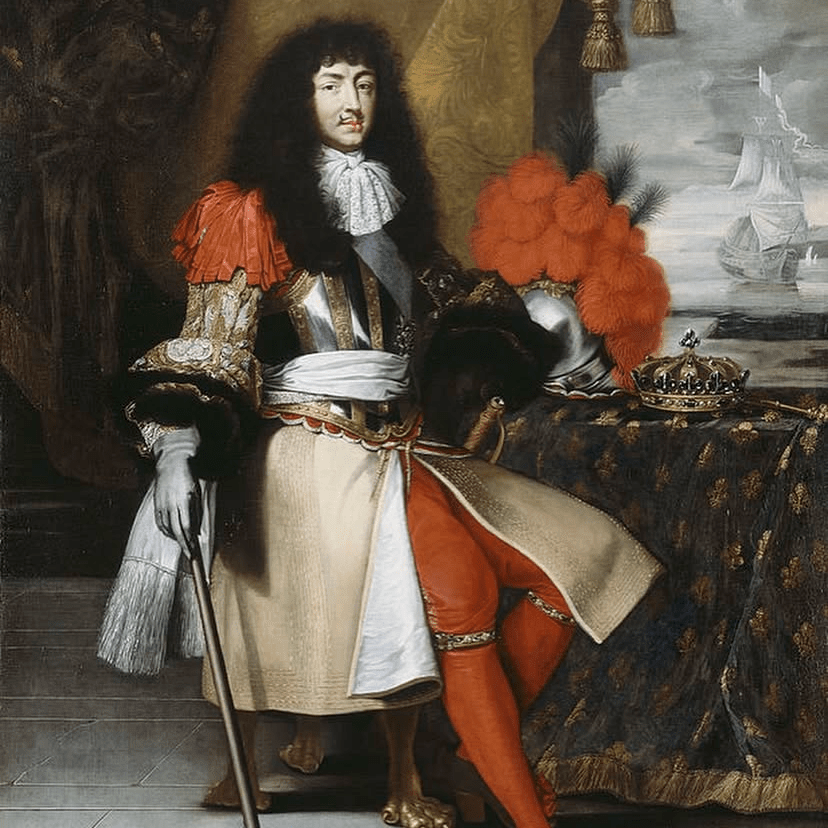
French monarch King Louis XIV was BOTD in 1638. Born in Fontainebleau, the son of King Louis XIII, he became king aged four, with his mother Anne of Austria and Cardinal Mazarin governing the country until he came of age. He assumed personal control of government when he was 23, reigning for an astonishing 72 years. A proponent of the divine right of kings to rule absolutely, his reign was characterised by extravagant spending (funded by punitive taxes) and his expansion and lavish decoration of the Palace of Versailles. Casting himself as a god-king, he adopted the sun as his unofficial emblem, becoming known as Le Roi Soleil (The Sun King). Under his rule, France became the most powerful country in Europe, expanding its colonial territories into the Americas, Africa and South-East Asia. Less popularly, his prosecution of Protestants prompted more than 200,000 Huguenots to emigrate to England and other territories. An enthusiastic patron of the arts, he supported the careers of playwrights Molière and Jean Racine, painter Charles Le Brun, architects Louis Le Vau and Gian Lorenzo Bernini and composers Jean-Baptiste Lully and François Couperin, and popularised the practice of classical ballet. In 1660, he married Princess Maria Theresa of Spain, with whom he had six children, fathering a further 16 children with a series of mistresses. Though rampantly heterosexual and somewhat homophobic, he grudgingly tolerated homosexuality due to his staggering number of gay relatives: his uncle César duc de Vendôme, whose Parisian townhouse was nicknamed “Hôtel de Sodome”; his brother Philippe, duc d’Orléans, who co-formed a secret brotherhood of gay aristocrats; and his illegitimate son Louis de Bourbon, who joined wicked uncle Philippe’s harem and was banished soon after, dying at 16. Louis died in 1715 aged 77, having survived all his legitimate children. He was succeeded by his five year-old great-grandson the Duke of Anjou, later King Louis XV. The Sun King’s reign became emblematic of the decadence of hereditary monarchy, sowing the seeds of social unrest that prompted the 1789 French Revolution and the abolition of the monarchy. A frequent subject in literature, Louis was a lead character in the novels of Alexander Dumas père, who expanded on the story of The Man in an Iron Mask, kept prisoner at Louis’ request for over 30 years. He has been played onscreen by William Bakewell, Richard Chamberlain, Leonardo DiCaprio, Alan Rickman and Jean-Pierre Léaud, and by George Blagden in the TV drama series Versailles.
King Louis XIV of France

 Super Gays Born on this Day