
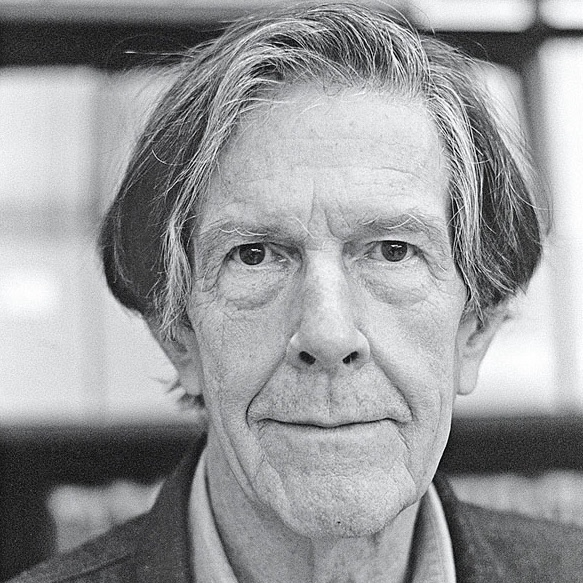
American composer John Cage was BOTD in 1912. Born in Los Angeles to a prosperous middle-class family, he studied briefly at Pomona College. He left before graduating to travel through Europe, encountering avant-garde composers including Igor Stravinsky and having a queer awakening after reading an unexpurgated version of Walt Whitman‘s Leaves of Grass. Returning to America in 1931, he studied 12-tone composition with Arnold Schoenberg. He married Russian sculptor Xenia Kashevaroff in 1935, living briefly in a menage-a-trois with her and choreographer Merce Cunningham. Cage and Kashevaroff separated in 1945 and he and Cunningham became one of the power couples of the post-World War Two avant-garde, mixing with Max Ernst, Peggy Guggenheim, Piet Mondrian, Marcel Duchamp and Jackson Pollock. Cage wrote a number of compositions for Cunningham’s modern dance pieces, most famously Cheap Imitations, based on a musical theme of Erik Satie. Much of Cage’s work was inspired by Zen Buddhism and chance theory, often using the I Ching or mathematical formulae to direct and complete his compositions. He also experimented with unorthodox instruments including the prepared piano, and incorporated tape recorders, record players and radios in an attempt to stretch the boundaries of Western music. His most well-known and controversial composition, 1952’s Four Minutes and Thirty-three Seconds, is a three-movement orchestral piece in which the musicians sit in silence without playing their instruments. Cage died in 1992, aged 79. Now considered one of the pioneers of 20th century experimental music, his disciples include Minimalist composer Philip Glass and bands The Beatles, The Velvet Underground and Sonic Youth. Cage’s 1987 organ piece As Slow As Possible is currently being performed at a church in Halberstadt, Germany: the performance started in 2001, with the next note due to be played on 5 August 2026 and is scheduled to finish in the year 2640.
John Cage

 Super Gays Born on this Day