
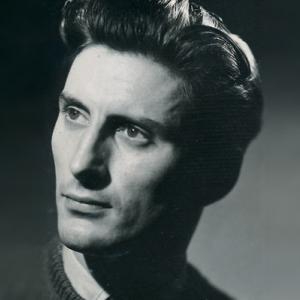
English artist and spy Brian Stonehouse was BOTD in 1918. Born in Torquay, Devon, his family moved to France when he was a child, and he was educated in Wimereux in Calais. He returned to England in 1932 to study at the Ipswich School of Art, and joined the Territorial Army at the outbreak of World War Two. Conscripted into the Royal Artillery as a gunner, he was re-deployed as an interpreter for French troops in Glasgow. In 1931, he was recruited into the Special Operations Executive, and trained in sabotage and unarmed combat. In 1942, he was parachuted into Nazi-occupied France, where he worked with the French Resistance, transmitting regular messages to London headquarters. Captured by the Gestapo a few months later, he was held in solitary confinement and subjected to brutal interrogations, involving beatings and torture. In 1943, he was shipped to Germany and sent to Mauthausen concentration camp, and briefly deployed in a Luftwaffe factory camp in Vienna. In 1944, he was transferred top the Natzwiler-Strudholdf camp in Alsace, where he escaped execution by making sketches of the camp commandants and their families. Transferred again to the death camp at Dachau, he survived to witness the camp’s liberation in 1945 by American forces, drawing sketches of the crematorium ovens as part of his SOE debrief. After the war, he gave testimony at the Nuremberg Trials of the murder of four female SOE agents, whose deaths he had witnessed a year before and whom he helped identify with sketches drawn from memory. He remained in military service, working for the Allied Control Commission in Frankfurt and assisting with the interrogation of former Gestapo officers. While preparing for the Nuremberg trials, he formed a relationship with American soldier Harry Haller. In 1946, he moved with Haller to the United States, where Heller recommended him to friends as a portrait painter. His sketches caught the eye of Jessica Daves at American Vogue, who hired him as an illustrator. He worked for Vogue for the next 20 years, becoming a fixture of New York high society, and making portraits of celebrities including Tallulah Bankhead, Richard Burton and Sophia Loren. His reign at Vogue came to an end in 1962 when editor Diana Vreeland replaced illustrators with photographers, but he continued working for cosmetics empire Elizabeth Arden. He returned to England in 1979, creating several portraits of the Queen Mother and becoming one of her regular lunch guests. He died in 1998, aged 80. After his death, his wartime sketches and memorabilia were donated to the Imperial War Museum in London.
Brian Stonehouse

 Super Gays Born on this Day