
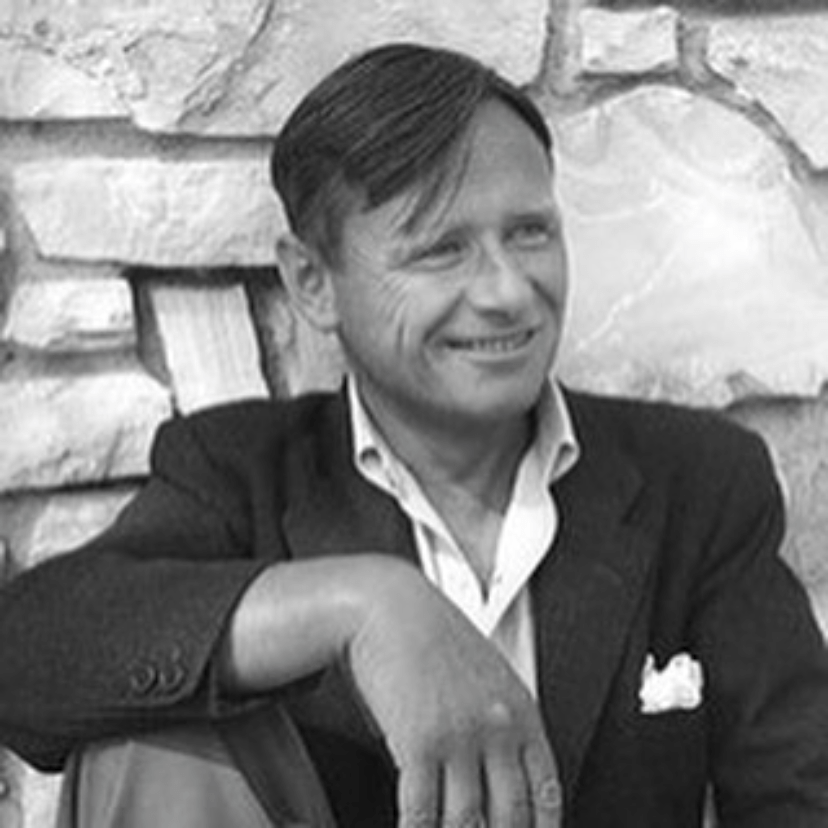
English writer Christopher Isherwood was BOTD in 1904. Born in High Lane, Cheshire, to an upper middle-class family, he studied at Cambridge University, where he befriended W. H. Auden and Stephen Spender and began publishing poetry. In 1929, he visited Berlin, meeting sexologist Magnus Hirschfeld and enjoying the sexual freedoms of the Weimar Republic. His experiences formed the basis of his short story collection Goodbye to Berlin featuring the ambitious showgirl Sally Bowles, named in admiration for his friend Paul Bowles. He left Germany in 1933 with his boyfriend Heinz Neddermeyer, travelling for three years in search of a home. In 1937, Neddermeyer was arrested and repatriated to Germany. A devastated Isherwood returned to England, before emigrating to America with Auden in 1939. Arriving in New York City, they lived briefly in a writers’ colony in Brooklyn with housemates Gypsy Rose Lee, Carson McCullers, Auden, Benjamin Britten, Peter Pears and Paul and Jane Bowles. Isherwood settled in California, befriending Truman Capote (whose novella Breakfast at Tiffany’s was a homage to Isherwood’s Sally Bowles stories), and lived with photographer Bill Caskey. Isherwood’s fame increased with John van Druten‘s 1951 play of his Berlin Stories, I Am a Camera, which in turn became the 1966 hit musical Cabaret, co-written by John Kander and Fred Ebb. The 1972 film version of Cabaret, directed by Bob Fosse and starring Liza Minnelli, Joel Grey and Michael York, became an international sensation, winning eight Oscars. Isherwood disapproved of Minnelli’s casting, considering her too talented to play the mediocre Sally, though approved of the handsome York playing his younger self. In 1953, aged 48, he met 16 year-old Don Bachardy at a trip to the beach. Despite, or perhaps because of their 32-year age gap, they became lovers, and began living together a few months later. Embraced the father-son dynamic of their relationship, Bachardy adopted Isherwood’s strangulated upper-class English accent, while Isherwood encouraged Bachardy’s love of drawing, paying for him to attend art school. Known as “the happiest couple in Hollywood”, their celebrity friends included Joan Didion, David Hockney, Montgomery Clift, Igor Stravinsky, Laurence Olivier, Bette Davis, E. M. Forster, W. Somerset Maugham, Truman Capote, Anthony Perkins and Tennessee Williams. Their loving but turbulent relationship formed the inspiration for Isherwood’s 1964 novel A Single Man, in which a middle-aged gay man confronts life after the sudden death of his younger lover. In 1973, they co-wrote the screenplay for the TV film Frankenstein: The True Story, a queer reading of Frankenstein incorporating elements of Oscar Wilde’s A Picture of Dorian Gray. He found a new generation of readers with his memoir Christopher and His Kind, published in 1976 at the height of the gay liberation movement. His later work was highly influenced by Hindu philosophy and he published translations of Vedic texts including the Bhagavad Gita. He died in 1986, aged 81, survived by Bachardy. Interest in his life and work was reignited with the 2007 documentary Chris and Don: A Love Story, and Tom Ford‘s 2009 film adaptation of A Single Man, starring Colin Firth as an unusually suave college professor based on Isherwood.
Christopher Isherwood

 Super Gays Born on this Day