
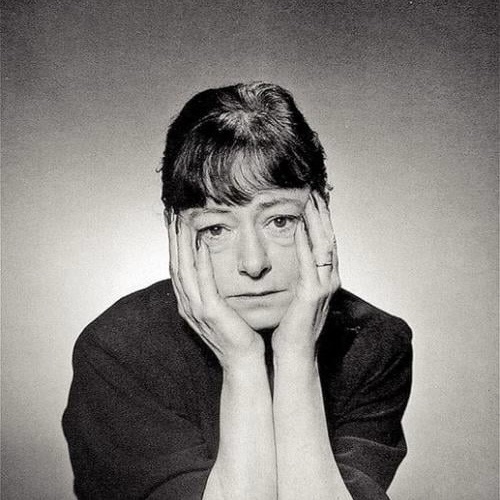
American writer and humorist Dorothy Parker was BOTD in 1893. Born in West End, New Jersey to an affluent middle-class family, she was educated at private schools, beginning her professional career as an editor for Vogue magazine. She rose to fame as a savagely funny drama critic for Vanity Fair, though her scathing critiques often offended actors and producers. (She infamously described Katharine Hepburn as “run[ning] the gamut of human emotion from A to B”). Fired by the magazine in 1920, she became a freelance writer. Her debut poetry collection Enough Rope became a bestseller, leading to a job offer and life-long association with the New Yorker magazine. In 1929, she won the O. Henry Award for her short story Big Blonde, an acerbic portrait of an ageing party girl, followed by the story collections Laments for the Living and After Such Pleasures. Famed as a conversationalist and wit, she was a founding member of the Algonquin Round Table, an informal gathering of rampantly alcoholic writers who traded witticisms over cocktails at the Algonquin Hotel (inspiring her bon mot “One more drink and I’ll be under the host.”) After divorcing her first husband (whose surname she kept), she married the bisexual actor and writer Alan Campbell in 1932. They relocated to Hollywood to become writers, earning Oscar nominations for their screenplay for 1937’s A Star is Born. Discarding her former persona as a socialite, Parker embraced left-wing politics, travelling to Spain to report on the Civil War. Blacklisted in post-war Hollywood for her suspected pro-Communist beliefs, she became a book reviewer for Esquire magazine. (In her review of Ayn Rand’s 1168-page novel Atlas Shrugged, she quipped, “This is not a novel to be tossed aside lightly. It should be thrown with great force”.) Her later years were plagued by alcohol abuse, repeated break-ups and reconciliations with Campbell, and a number of unhappy affairs, including a decades-long unrequited crush on fellow writer Robert Benchley. After Campbell’s death, she returned to New York, dying in 1967 aged 73, and leaving her estate to civil rights activist Martin Luther King Jr. (Her self-penned epitaph for her gravestone reads “Excuse my dust”). Now acknowledged as one of the wittiest writers of the 20th century, her work has never been out of print. Her most memorable one-liners include “Men seldom make passes at girls who wear glasses“, “Beauty is only skin deep, but ugly goes clean to the bone” and “You can lead a horticulture, but you can’t make her think.” Though heterosexual (“I require three things in a man: he must be handsome, ruthless and stupid“), her caustic wit and world-weary cynicism have been influential on generations of gay writers, notably Truman Capote. (“Heterosexuality is not normal”, she once quipped, “it’s just common”). She has been portrayed many times on screen, notably by Jennifer Jason Leigh in the 1994 biopic Mrs Parker and the Vicious Circle, and by drag queen Miz Cracker in the 2018 season of RuPaul‘s Drag Race.
Dorothy Parker

 Super Gays Born on this Day