
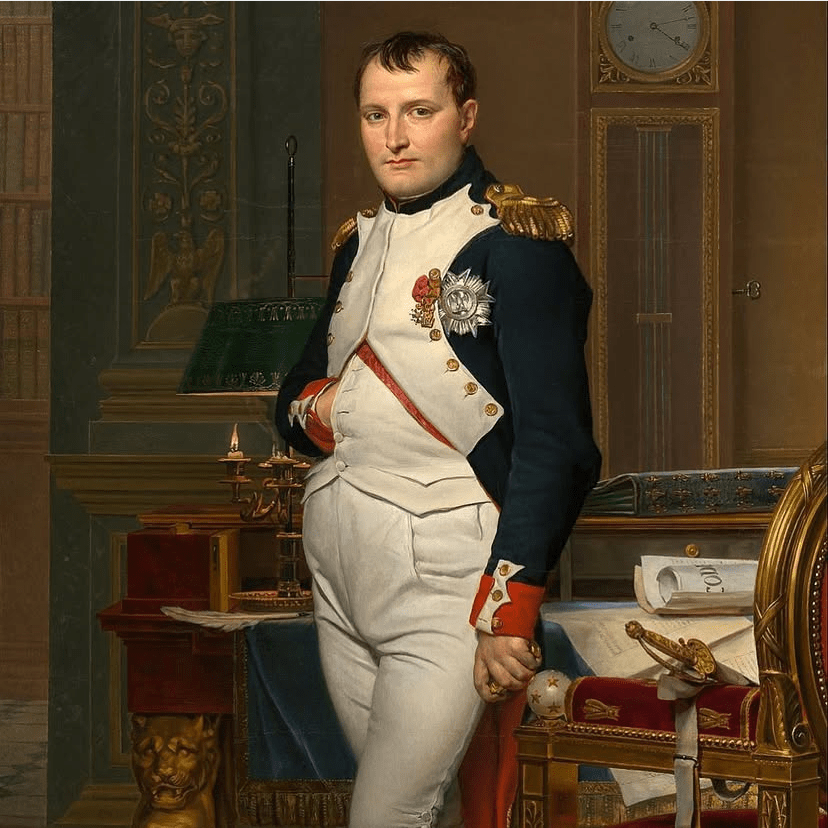
French military commander and emperor Napoleon Bonaparte was BOTD in 1769. Born in Ajaccio in French-controlled Corsica to a middle-class family, he was sent to Paris in 1778 to be educated at the Collège d’Autun. After six years of military college, he joined the French Army as a second lieutenant. In 1789, he joined the Jacobin Club, eventually becoming its president and advocating for a constitutional monarchy. Short of stature but big on ambition, he rose through the military ranks, earning praise for his bravery in combat. By 1795, he was the chief military advisor to the post-Revolutionary government, leading a number of successful campaigns in Austria and Sardinia, though his attempts to annex Egypt and Syria ended in a retreat. He returned to France in 1799 to lead the overthrow of the government, eventually crowning himself Emperor in 1804. He sponsored major reforms to French civil law and the judicial system, including the Napoleonic Code, which recognised individual liberty, freedom of conscience and equality before the law. The Code also decriminalised male homosexuality, making France the first Western European country to do (and leading to homosexuality being referred to abroad as “Le vice français“). Intent on dominating Europe, he led a series of successful military campaigns, annexing much of Italy, Germany, Poland, the Netherlands, Spain and Portugal. His 1812 invasion of Russia resulted in a humiliating retreat, and he was finally defeated in 1813 in the Battle of Leipzig. Deposed and imprisoned, he managed to escape and raise an army, but was defeated again at the Battle of Waterloo. Exiled to the island of Saint Helena, he died in 1821 aged 51. Napoleon was married twice, to Joséphine de Beauharnais, who was crowned Empress alongside him. After Josephine failed to produce an heir, Napoleon rather callously traded her in for Marie-Louise, Archduchess of Austria, with whom he had a son. His sexual attraction to male soldiers was well-documented: he once confided to a friend that whenever he met a handsome man, his admiration was felt “first in the loins and then another place I will leave unnamed”. He surrounded himself with pretty young aides-de-camp and an astonishing number of homosexual aristocrats, at least two of whom, General Duroc and Gaspard Gourgaud, were thought to be his lovers (giving new meaning to the phrase, “Not tonight, Josephine”). Via the Napoleonic Code, tolerance of “Le vice français” spread to most of the Napoleonic Empire and to France’s overseas colonies in the 19th century.
Napoleon Bonaparte

 Super Gays Born on this Day