
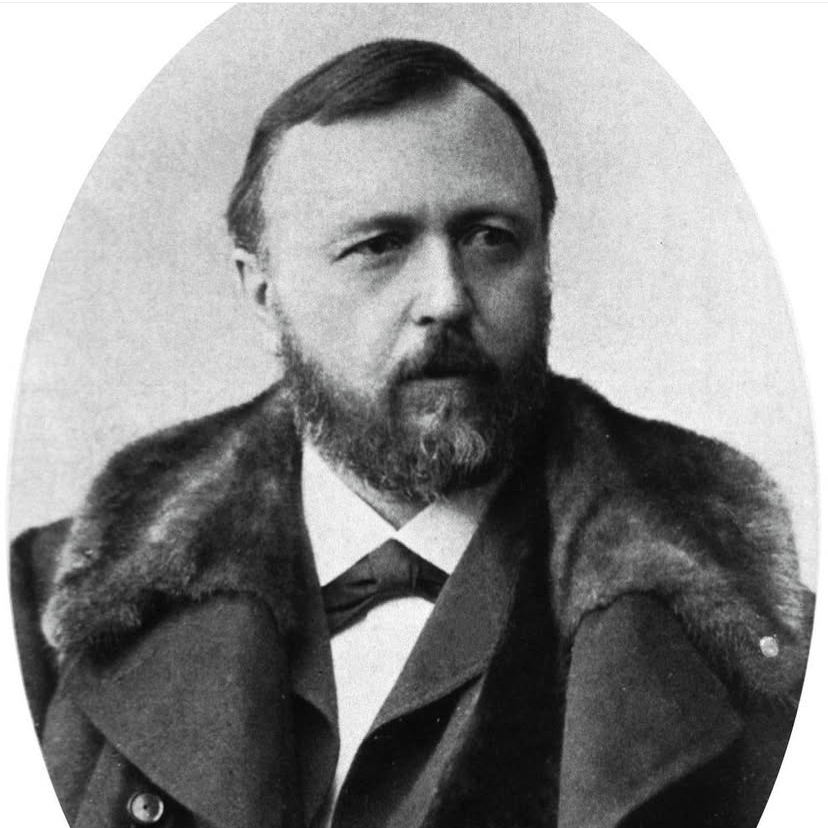
German sexologist Richard, Baron von Krafft-Ebing was BOTD in 1840. Born in Mannheim in the Duchy of Baden, his father was a prominent jurist who had been ennobled as a baron in 1805. He studied medicine at Ruprecht-Karls-University in Heidelberg, specialising in psychiatry, and spent many years working in asylums. After his father’s death in 1867, he assumed the title of Baron von Ebing and established his own neurology practice in Baden-Baden, where he married and had two children. During the Franco-Prussian War, he served as a field hospital doctor, and oversaw the care of wounded soldiers. In 1872, he opened a psychiatric clinic at the University of Strasbourg, and was appointed director of a state asylum at Feldhof, publishing several textbooks on the nascent field of criminal psychology. He is best known for his 1886 book Psychopathia Sexualis, in which he presented case studies of various sexual “pathologies”, coining the terms “bisexuality”, “masochism” (named for Austrian writer Leopold von Sacher-Masoch) and “necrophilia” and providing a psychological analysis of sadism. He argued that procreation was the sole purpose of sexual desire, but concluded homosexuality was a naturally occurring “differentiation” that should not be viewed as a perversion or a mental illness. Psychopathia Sexualis was translated into several languages and published internationally, leading to his appointment as professor of psychiatry at the University of Vienna. He retired from academia in 1902, dying a few months later, aged 62. Psychopathia Sexualis remained a standard text, inspiring the work of sexologists Magnus Hirschfeld and Sigmund Freud, and became a popular sexual guidebook for generations of queer people attempting to understand their own sexuality. Among his celebrity readers were writers Thomas Mann and Radclyffe Hall, who cited and adopted his theories of sexual inversion. By the mid-20th century, Krafft-Ebing’s theories were largely eclipsed by Freud, who viewed homosexuality as a psychological disorder. Homosexuality was finally removed from the American Psychiatric Association’s list of mental disorders in 1973, nearly 100 years after Krafft-Ebing’s work.
Richard von Krafft-Ebing

 Super Gays Born on this Day