
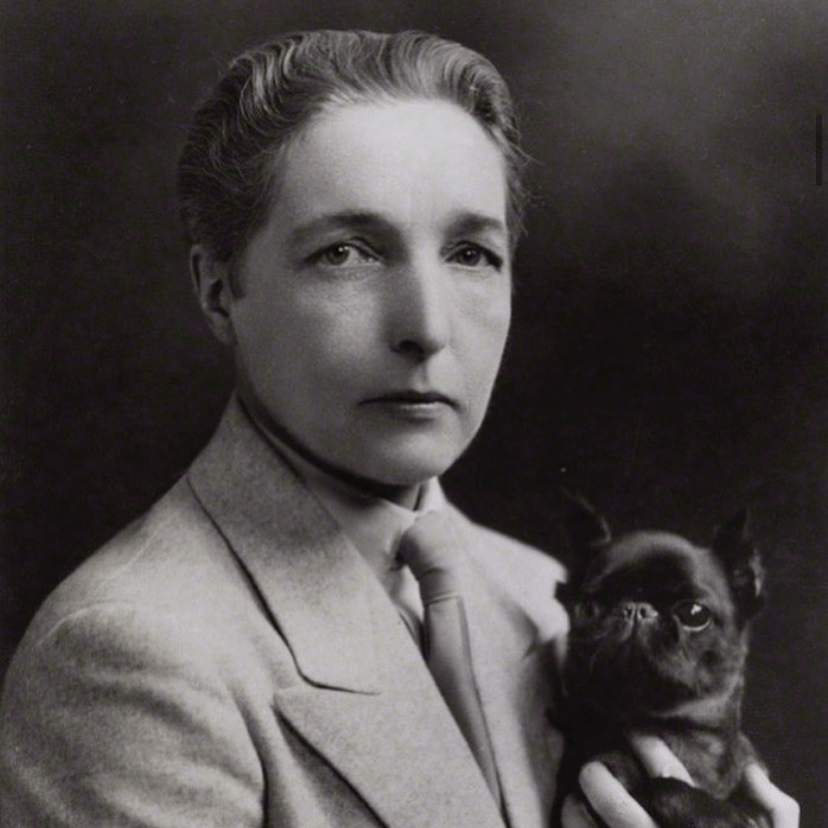
English writer Radclyffe Hall was BOTD in 1880. Born in Bournemouth, Hampshire to a wealthy upper-middle-class family, they were assigned female at birth and christened Marguerite Antonia Radclyffe Hall. Their father abandoned the family home when they were a child, and they were raised in unhappy isolation by their unstable, abusive mother and legions of servants. Largely educated by tutors, they moved to London to attend classes at Kings College, followed by finishing school in Germany. A generous inheritance from their father allowing her to live independently and pursue a career as a writer. Having identified as male from early childhood, they adopted the name “John”, dressed in tailored men’s clothes and had a series of unhappy affairs with married women. In 1907, she met Mabel Batten, a married women twice their age. After Batten’s husband’s death, they began living together, with Batten introducing Hall to her circle of lesbian friends and encouraging them to publish her poetry. In 1915, Hall had an affair with Batten’s cousin Una Vincenzo, Lady Troubridge, ricocheting between them uneasily for until Batten’s death the following year. Hall lived in an open relationship with Troubridge for the rest of their life. After publishing several volumes of bad poetry and two novels, Hall found critical and commercial success with the 1926 novel Adam’s Breed, winning the Prix Femina and the James Tait Black Prize. They are best known for her 1928 novel The Well of Loneliness, an earnest melodrama about an aristocratic woman named Stephen who, like Hall, identifies as an “invert” and is attracted to women. The novel’s frank discussions of lesbian desire horrified critics and politicians, prompting an obscenity trial in Britain, where it was eventually banned. After a long court battle, the book was published in the United States, where it became a bestseller. As one of the few publicly available texts about lesbianism, the book became a rite-of-passage for generations of readers, and Hall’s and Troubridge’s androgynous appearance was widely copied by their fans. They retired to Rye in East Sussex in the 1930s, raising dachshunds and griffons, and posing for portraits by their friend Romaine Brooks. Hall published only one further novel, the poorly-reviewed The Master of the House. In later years, they had a brief affair with composer Ethel Smyth and a decade-long relationship with Evgenia Souline (a Russian nurse hired by Troubridge to care for Hall during an illness). Troubridge tolerated Hall’s infidelities, even allowing Souline to live with them in a ménage-à-trois. The resulting scandal prompted them to move together to Italy, living briefly in Florence until the outbreak of the Second World War. The trio settled in Devon, where Hall died of rectal cancer in 1943, aged 63. Troubridge became Hall’s literary executor, continuing to promote The Well of Loneliness until her own death in 1958. It remains a bestseller, and has become one of the most famous and widely-read LGBTQ novels in the world. In recent years, critics and academics have proposed that Hall and their fictional alter-ego Stephen should be identified as trans and described using “they/them” pronouns, prompting discussion of The Well of Loneliness as a proto-trans text.
Radclyffe Hall

 Super Gays Born on this Day