
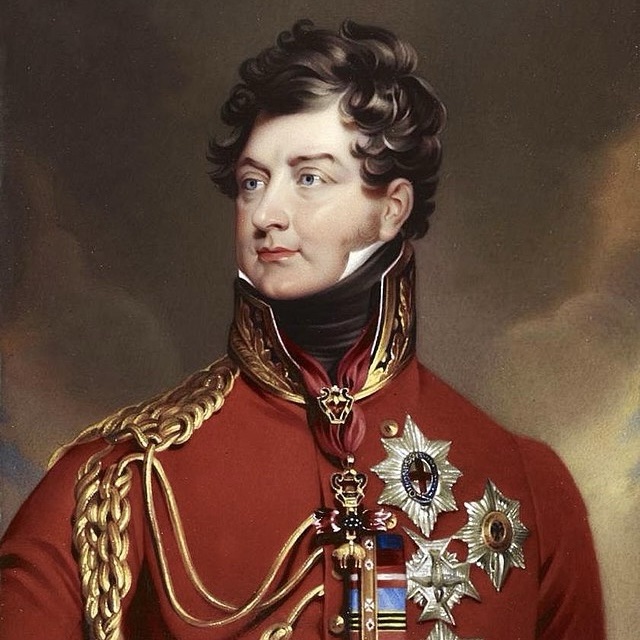
English monarch Prince George of Hanover, latterly the Prince Regent and King George IV of Great Britain and Hanover, was BOTD in 1762. Born at Windsor Castle, he was the eldest son of King George III of Great Britain and Hanover, becoming, at birth, the heir to both kingdoms. By his late teens, he was a renowned socialite, womaniser and spendthrift, earning his father’s lasting disapproval. In 1784, he secretly married his mistress Maria Fitzherbert, a union later declared legally invalid. In 1795, in an attempt to persuade Parliament to pay his debts, he entered into an arranged marriage with his first cousin Caroline of Brunswick. They separated the following year, shortly after the birth of their daughter Princess Charlotte. In 1810, George III was declared unfit to rule due to mental illness, and George Jr was appointed regent by Parliament. As the Prince Regent, he oversaw a period of economic prosperity and political dominance in England, cemented by Admiral Nelson’s defeat over Napoleon in 1812. Following the death of his father in 1820, he was crowned King George IV, in an extravagant ceremony designed to rival Napoleon’s. Caroline returned from exile to claim her rights as queen consort, though was denied entrance to the ceremony, and died the following year. George continued to spend lavishly, employing the architect John Nash to redevelop central London in the neo-Classical “Georgian” style, including the construction of Regent Street and Regent’s Park. He also commissioned Nash to construct an Orientalist pavilion in Brighton, inspired by Mughal Indian and Chinese royal palaces. Continually in debt, he was dependent on Parliament for frequent bail-outs, and was a popular target of satire in the press. His close friendships with Whig politician Charles James Fox and fashionista Beau Brummell also prompted rumours (and several excellent jokes) about his possible bisexuality. In the final years of his life, he had little involvement with government, spending his time in seclusion at Windsor Castle and suffering from gout and obesity. He died in 1830, aged 67. Hid popular reputation as a dissolute idiot has survived until the present day, largely thanks to Hugh Laurie’s memorable caricature in 1980s TV comedy series Blackadder III. He has also been played onscreen by Rupert Everett in the film The Madness of King George (based on Alan Bennett‘s stage play), Tim McInnerny in the film Peterloo and Mark Gatiss in the 2017 TV series Taboo.
King George IV

 Super Gays Born on this Day