
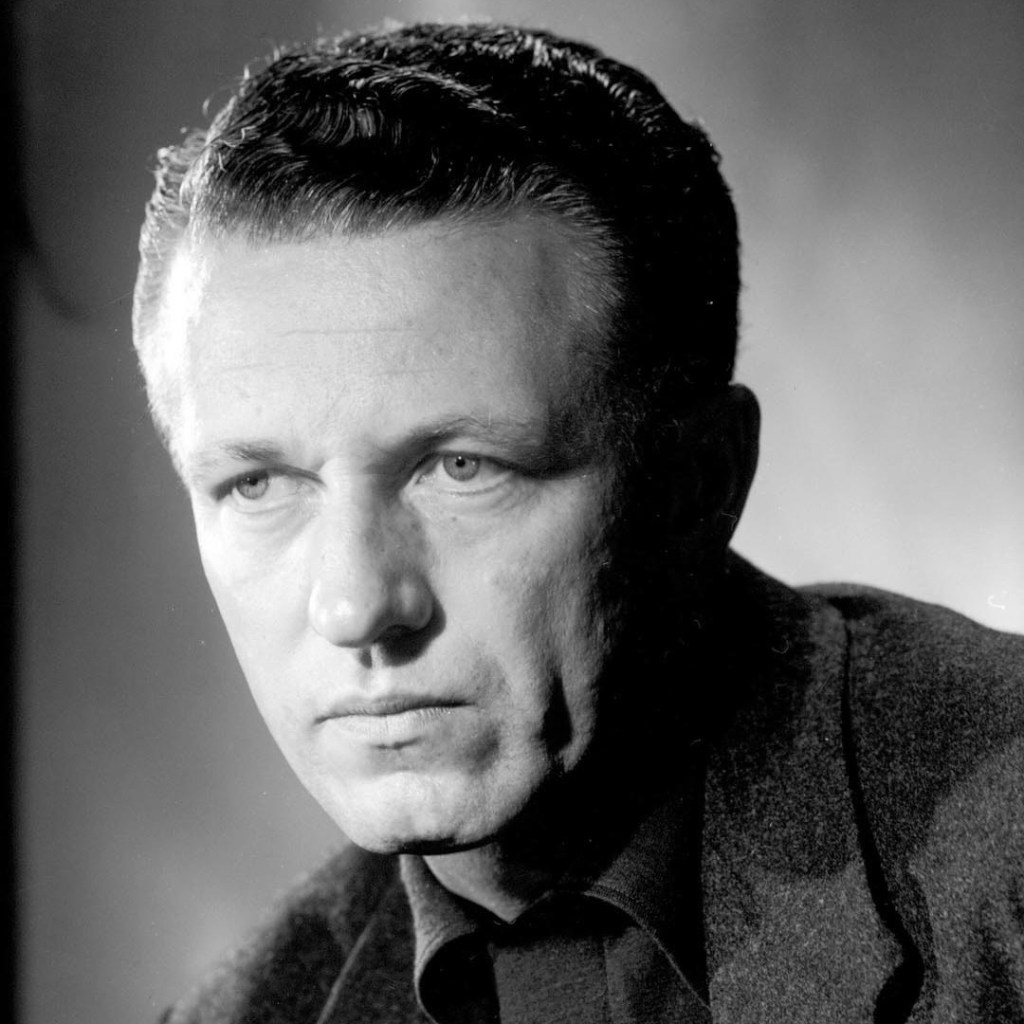
American filmmaker Nicholas Ray was BOTD in 1911. Born in Galesville, Wisconsin, he grew up in La Crosse and studied at the University of Chicago. He moved to New York City in the 1930s, joining a Communist theatre group where he befriended lefty directors Elia Kazan and Joseph Losey. During World War Two, he directed propaganda films for the United States Office of War Information. After the war, he followed Kazan to Hollywood, signing a contract with Howard Hughes at RKO Pictures. He made an impressive directorial debut with the 1948 film noir They Live By Night, starring Farley Granger. While making his second film A Woman’s Secret, he had an affair with and later married his leading lady Gloria Grahame. Their marriage was short-lived, possibly not helped by Grahame having an affair with Ray’s teenaged son from a previous marriage. They worked together again on 1950’s In a Lonely Place, starring Humphrey Bogart as a manic-depressive screenwriter, a performance thought to be closely based on Ray. He had a difficult relationship with Hughes, who shielded him from Joseph McCarthy’s anti-Communist purges but assigned him a series of unremarkable projects throughout the 1950s. Ray skipped to another studio to make Johnny Guitar, a Technicolor Western starring Joan Crawford as a butch saloon owner battling to the death with her Sapphic nemesis Mercedes McCambridge. He achieved major critical and commercial success 1955 film Rebel Without a Cause, starring James Dean as a troubled teenager railing against Eisenhower-era society. Ray and Dean had a tempestuous, erotically-charged relationship during filming, with biographers continuing to debate whether they were actually lovers. Ray also nudged Dean’s co-star Sal Mineo out of the closet, to give a moving and authentic performance as a closeted gay teenager, and had a brief affair with 16 year-old Natalie Wood, at the time 27 years his junior. Rebel became a landmark film, vaulting Dean to stardom and anticipating 1960s counter-culture in its critique of social norms. While promoting the film in England, Ray had an affair with screenwriter Gavin Lambert, who became his “assistant”, eventually moving with him to Hollywood. They collaborated together on Ray’s films The True Story of Jesse James, Bigger Than Life and the box-office hit Bitter Victory. After the commercial failure of his film 55 Days at Peking, Ray quit Hollywood and moved to Paris, where he became hugely influential on French New Wave directors Jean-Luc Godard and François Truffaut. Later in life, he made cameo appearances in Wim Wenders’ The American Friend, based on Patricia Highsmith‘s novel Ripley’s Game, and in Miloš Forman’s musical film Hair. He also became known for wearing an eyepatch following an embolism, adding to his auteurish mystique. He died in 1979 aged 67. Now hailed as one of Hollywood’s most original filmmakers, his films have influenced the work of Martin Scorsese, Francis Ford Coppola, Robert Altman, David Lynch and Kathryn Bigelow.
Nicholas Ray

 Super Gays Born on this Day