
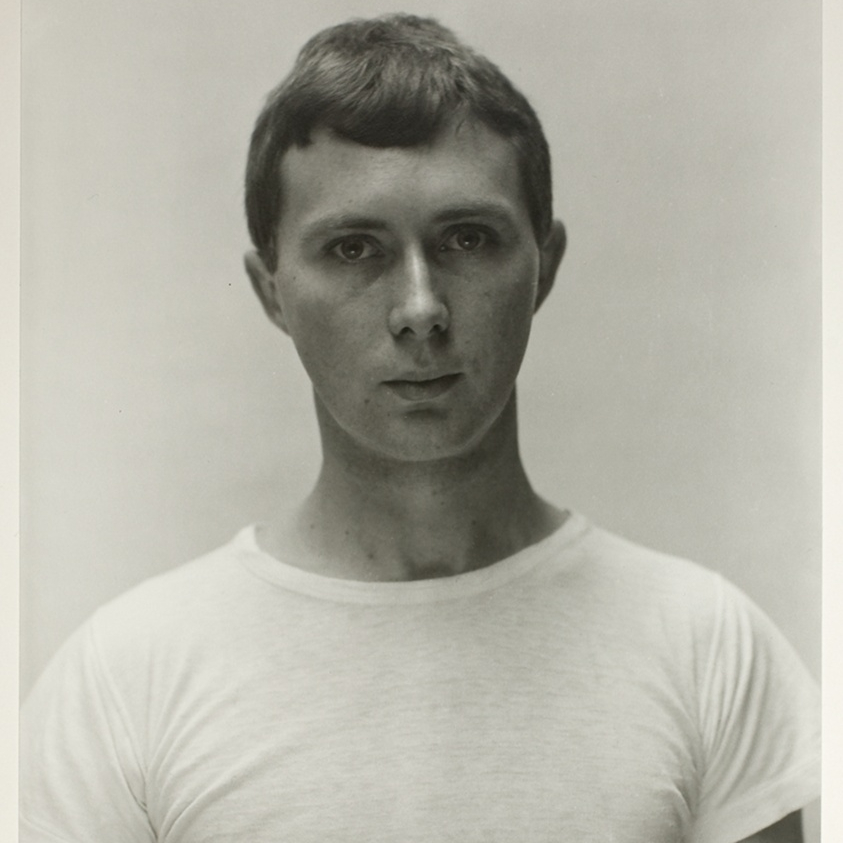
American artist George Tooker was BOTD in 1920. Born in Brooklyn, New York City, he was raised in Long Island, where he began taking painting lessons. He studied at the Phillips Academy and Harvard University, majoring in English literature. Following the United States entering the Second World War, he joined the Marine Corps in 1942, though was soon discharged for health reasons. Returning to New Tork, he enrolled at the Art Students League where he met fellow painter Paul Cadmus, who became a lifelong friend. He relocated to Greenwich Village in 1945 and, via Cadmus and mutual friends Jared and Margaret French, befriended a circle of celebrity homosexuals including Lincoln Kirstein, W. H. Auden, Christopher Isherwood, Glenway Wescott, Monroe Wheeler and George Platt Lynes. At Cadmus’ and French’s suggestion, he began painting with egg tempera, a Renaissance-era painting technique largely unused since the introduction of manufactured paints in the late 19th century. His work typically featured scenes of social and existential dread in contemporary urban life, featuring flat tones, unforgiving shadowless light and claustrophobic framing. Kirstein arranged for Tooker’s work to be included in the 1946 Fourteen Americans exhibition at the Museum of Modern Art, and the 1950 Symbolic Realism shows in New York and London, significantly boosting his public profile. The Whitney Museum of American Art later acquired his painting The Subway and he had his first solo exhibition in 1951. In 1949, he met fellow William Christopher, who became his life partner, living together in Brooklyn before moving to Hartland, Vermont. They both became active in the Black Civil Rights movement, travelling to Alabama in 1965 to participated in one of the Selma to Montgomery Marches led by Martin Luther King Jr. To escape the harsh Vermont winter, they began spending winters in Andalusía in southern Spain, eventually buying an apartment in Málaga in 1968. After Christopher’s death in 1973, Tooker converted to Roman Catholicism, becoming deeply involved with his local church in Windsor, Vermont, for which he painted an elaborate seven-panelled work The Seven Sacraments. His work had a major revival in popularity in the 1980s, and he was the subject of retrospectives at the Marsh Gallery in Richmond, Virginia, the Addison Gallery of American Art in Andover, Massachusetts, the Pennsylvania Academy of Fine Arts and the Columbus Museum of Art, Ohio. In 2007, he was awarded the National Medal of Arts in 2007. He died in 2011, aged 90.
Though popular in the 1940s, his work fell out of fashion when Abstract Expressionism gained popularity, and was rediscovered in the 1980s.

 Super Gays Born on this Day