
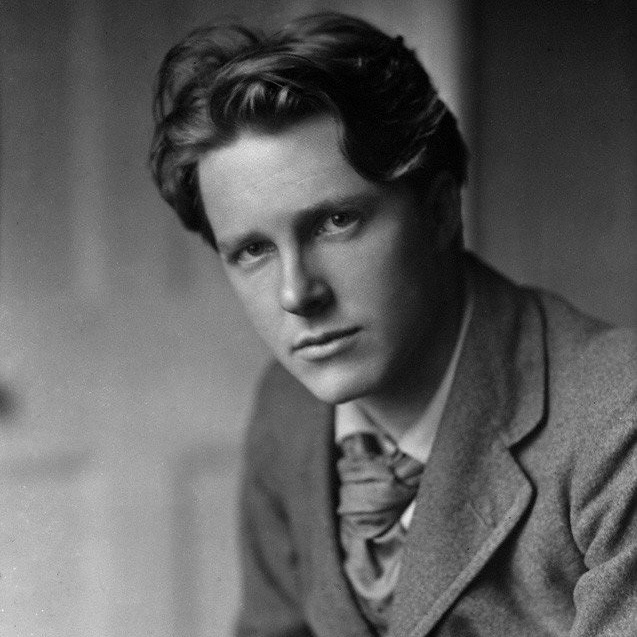
English poet Rupert Brooke was BOTD in 1887. Born in Rugby, Warwickshire to an upper-middle class family, he attended the prestigious Rugby School, where his father was a schoolmaster. He went onto Cambridge University, where he flirted with Socialism and had affairs with several of his male classmates. He published his first poetry collection in 1911, filled with allusions to his own bisexuality. Handsome, charming and floppy-haired in the manner of Hugh Grant, he became the resident heartbreaker of the Bloomsbury Group, stirring the loins of Virginia Woolf (with whom he went skinny-dipping), Lytton Strachey and Duncan Grant. Describing himself as both homosexual and heterosexual, he had affairs with men and women, and a lifelong, erotically-charged friendship with Winston Churchill. Unable to reconcile himself to his homosexuality, Brooke suffered a nervous breakdown in 1912 and was hospitalised. Resolving to embrace a heterosexual life, he abandoned the Bloomsbury Group and travelled to Germany, returning to England at the outbreak of World War One. Seeing war as an opportunity for his own moral purification, he enlisted with the Royal Navy. After three months sailing with British Mediterranean Expeditionary Force in 1915, the ship headed to Turkey to join the Gallipoli campaign. Brooke contracted sepsis after a mosquito bite, and died aboard a hospital ship off the coast of Skyros, aged 27. A collection of his wartime sonnets were published months after his death, titled 1914, and became hugely successful, presenting an idealised and romantic view of war and sacrifice. His most celebrated poem The Soldier (“If I should die, think only this of me: / That there’s some corner of a foreign field / That is forever England”) became an anthem for English patriotism, while his grave in Skyros became a popular pilgrimage for his many fans. The poetry of Siegfried Sassoon and Wilfred Owen, portraying the horrors of trench warfare, was direct challenge to Brooke’s naive idealism. Brooke’s executors, keen to maintain his image as a war hero, censored the homosexual references in his poetry and correspondence for many decades.
Rupert Brooke

 Super Gays Born on this Day