
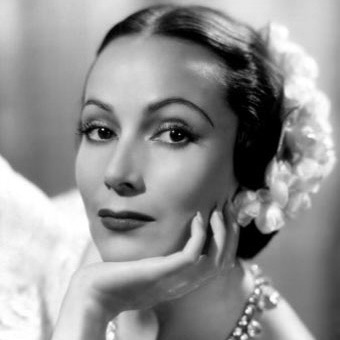
Mexican actress and singer Dolores del Río was BOTD in 1904. Born Lolita Dolores Asunsolo y Martinez in Durango to a wealthy aristocratic family, she was educated in private schools, spending most of her adolescence in Europe and the United States. After seeing ballet star Anna Pavlova perform, she In 1921, aged 17, she married the wealthy aristocrat Jaime Martínez del Río. After a glamorous European honeymoon, during which she danced for the King and Queen of Spain, they returned to Jaime’s ranch in Durango, losing their fortune during the Great Depression. In 1925, their friend the painter Adolfo Best Maugard convinced del Río to move to Hollywood and pursue an acting career. She was quickly signed to a contract with First National Pictures, making her film debut in 1925. Her breakthrough came in the 1926 war film What Price Glory?, catapulting her to fame. She became one of the most popular stars of Hollywood silent cinema, typically playing “exotic” beauties in films including Resurrection, The Trail of ’98. Ramona and Evangeline. After divorcing Jaime, she successfully transitioned to talking pictures, making huge successes in Bird of Paradise, the Fred Astaire-Ginger Rogers musical Flying Down to Rio, Madame du Barry and the Busby Berkeley-directed I Live for Love. Eventually labelled “box office poison” and tiring of her type-casting as a “Latin lover”, she returned to Mexico in 1943, starring in the highly successful Mexican-language film Flor silvestre (Wild Flower). She become a prominent star in the Golden Age of Mexican Cinema, with hits including María Candelaria, Las Abandonadas (The Abandoned), La selva de fuego (The jungle of fire andLa Otra (The Other), and also appeared in John Ford’s film The Fugitive. In 1948, she travelled to Argentina to film Historia de una mala mujer (History of a Bad Woman), a Spanish-language adaptation of Oscar Wilde‘s play Lady Windermere’s Fan. Argentinean First Lady and former actress Eva Perón became so obsessed with meeting del Río that she had the government shut down the film studios until del Río attended her tea party at the presidential palace. Del Río continued working into the 1950s with films including Doña Perfecta and El Niño u la Niebla (The Boy and the Fog), though she was blocked from returning to Hollywood over her associations with Communists. After an extensive North American publicity tour in which she rejected any support for Communism, she won a role in the TV series Schlitz Playhouse of Stars with César Romero. She finally returned to Hollywood in 1960, playing Elvis Presley‘s mother in Flaming Star, working again with Ford in Cheyenne Autumn and the Italian film C’era una volta (More Than a Miracle) with Sophia Loren. In later life, she became involved in philanthropic causes, helping co-found a day care centre for the Mexican Actor’s Guild and collecting lifetime achievement awards from international film festivals. She made final film appearance in 1978’s The Children of Sanchez, with Anthony Quinn. Married two further times, she had affairs throughout her life with men and women including Cedric Gibbons, Errol Flynn, Erich Maria Remarque, Marlene Dietrich, Orson Welles, Lewis A. Riley and Frida Kahlo. She died in 1983, aged 78.
Dolores del Río

 Super Gays Born on this Day