
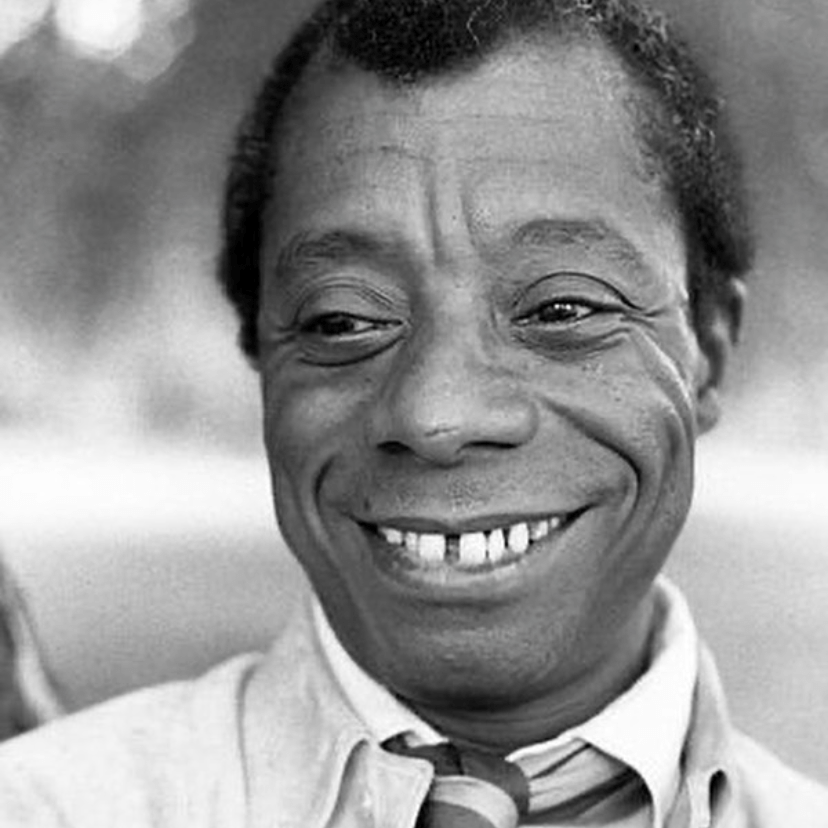
American writer and activist James Baldwin was BOTD in 1924. Born and raised in Harlem, New York City, he was a gifted student, and accepted to the prestigious and majority-white attended De Witt Clinton High School, editing the school’s newsletter with long-time friend Richard Avedon. He left in 1941 to earn money and provide for his family, working variously in labouring jobs. Troubled by his homosexuality, he took refuge in evangelical Christianity, attempting unsuccessfully to pray the gay away. Eventually admitting defeat, he moved to Greenwich Village where he discovered gay nightlife, Socialism and Marlon Brando, and began publishing short stories and essays. Disillusioned with American racism, he relocated to Paris in 1948, where he befriended Jean-Paul Sartre, Simone de Beauvoir, Jean Genet, Max Ernst, Stephen Spender and long-term frenemy Truman Capote. He made a splash with his 1953 debut novel Go Tell It On the Mountain, a feverish roman-a-clef about a young gay Black man attempting to suppress his homosexuality with religion. Major success followed with his 1955 essay collection Notes of a Native Son, an eloquent analysis of institutional racism in the United States. His second novel Giovanni’s Room, a heartbreaking account of a white American man who abandons his male lover for a passionless marriage, was rejected by his publisher. Published in 1955, it caused a scandal with its (for the time) frank depictions of homosexuality. He returned to the United States in 1957 to join the Black civil rights movement, appearing in protests alongside Martin Luther King Jr, Medgar Evers, Malcolm X, Nina Simone, Langston Hughes, Josephine Baker and Brando. He became one of the leading intellectuals of his generation, mapping the intersections between race, class, gender and sexuality in his novel Another Country and his essay The Fire Next Time, and making dazzlingly eloquent appearances in public lectures, debates and TV interview shows. In 1970, he settled in Saint-Paul-de-Vence in southern France, where he wrote his final novel, If Beale Street Could Talk, a love story about a young Black couple separated by a corrupt and racist legal system. Openly gay since forever, he had a three-year relationship with Lucien Happersberger in the late 1940s, remaining friends until his death in 1987, aged 63. Widely viewed as one of the greatest writers of the 20th century, he mentored a generation of Black writers including Lorraine Hansberry, Maya Angelou, Alex Haley, Toni Morrison and Henry Louis Gates Jr. His essays gained new currency during the Black Lives Matter movement, and his trademark brand of eloquent outrage has been widely imitated, notably by the writer Ta-Nehisi Coates. Baldwin’s unfinished essay Remember this House became the basis for Raoul Peck’s 2016 documentary I Am Not Your Negro. Barry Jenkins’ film adaptation of If Beale Street Could Talk, the first adaptation of a Baldwin novel, became one of 2018’s most celebrated films, nominated for three Oscars and winning for Regina King’s performance as a crusading matriarch. In 2019, Baldwin was inducted into the National LGBTQ Wall of Honor at the Stonewall Memorial in New York City. The actor Billy Porter has long threatened to write, produce and star in a biopic of Baldwin, a project that (perhaps thankfully) has yet to be realised.
James Baldwin

 Super Gays Born on this Day