
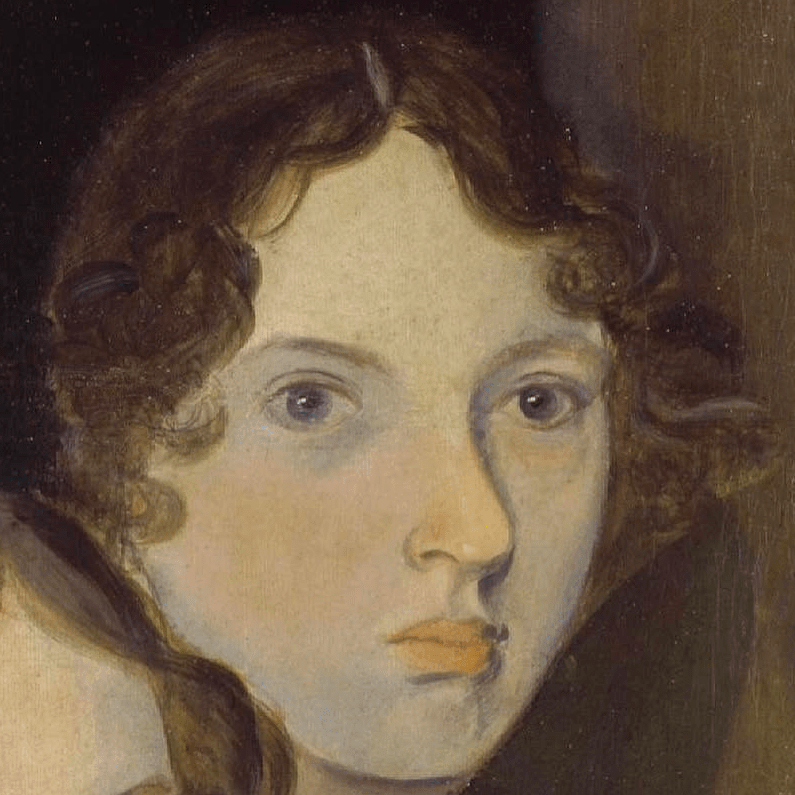
English writer Emily Brontë was BOTD in 1818. Born in Thornton, Yorkshire, the second youngest child of an Irish-born rector, she and her siblings were raised in a vicarage near Haworth, where her father was a curate. After the death of her mother, she was sent briefly to a school in Lancashire, returning home after the school’s poor living conditions led to the deaths of her sisters Maria and Elizabeth. She and her siblings Charlotte, Anne and Branwell were educated largely at home, co-creating the imaginary world of Angria, which inspired vast volumes of stories, biographies and histories. She worked briefly as a teacher before poor health forced her to return home. She and Charlotte later studied in Brussels in the hope of opening their own school, but struggled to attract pupils. In 1845, Charlotte, Emily and Anne jointly published a volume of verse, using the male pseudonyms Currer, Ellis and Acton Bell. Following the success of Charlotte’s novel Jane Eyre in 1847, their publishers agreed to publish Emily’s novel Wuthering Heights, jointly released with Anne’s Agnes Grey. A Gothic-inspired drama set on the Yorkshire moors, Wuthering Heights chronicled the passionate but self-destructive love of Catherine Earnshaw for the charismatic and sadistic Heathcliff, igniting a cycle of violence that infects the next generation. (The Byronic Heathcliff was based on Branwell, a drug addict who had an affair with a married woman and disgraced the family’s reputation). The book shocked readers with its “savage” Yorkshire dialect, graphic depictions of physical and sexual violence and suggested necrophilia. Graham’s Lady Magazine described the novel as “a compound of vulgar depravity and unnatural horrors,” while Paterson’s Magazine advised readers to “read Jane Eyre, but burn Wuthering Heights“, though it attracted praise from Victorian poets Dante Gabriel Rossetti and Algernon Charles Swinburne. Emily died of tuberculosis in 1848, three months after Branwell’s death. She was 30. After Emily’s death, Charlotte published a second edition of Wuthering Heights in 1850, adding a sympathetic biographical sketch of her sister and discreetly removing some of its more disturbing passages. Her literary reputation was salvaged in the 20th century, as society became more accustomed to vulgar depravity, and Wuthering Heights was championed by writers including John Cowper Powys, Virginia Woolf, Lord David Cecil and Daphne du Maurier. The book’s popularity was further boosted by a series of successful screen adaptations, notably William Wyler’s 1939 film starring Merle Oberon and Laurence Olivier. In 1978, the novel again rose to popular consciousness as the inspiration for the hit single Wuthering Heights, written by Emily’s birthday twin Kate Bush and performed in an eerie soprano that captured the novel’s frenzied romanticism. Emily’s life and sexuality have been extensively debated by critics. In her 1983 biography, Stevie Davies asserted that Emily was a lesbian, who possibly had relationships with her school friend Louise de Bassompierre and the cross-dressing aristocrat Anne Lister.
Emily Brontë

 Super Gays Born on this Day