
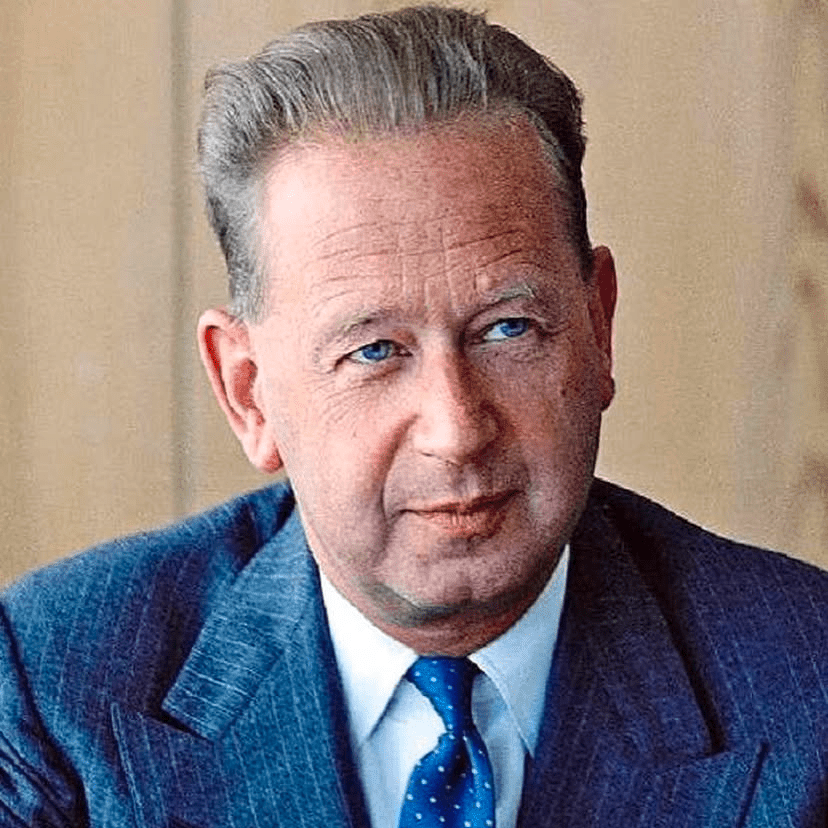
Swedish diplomat and statesman Dag Hammarskjöld was BOTD in 1905. Born in Jönköping to a prominent political family, his father became Sweden’s Prime Minister in 1914, steering the country through World War One. Hammarskjöld studied law and economics at Uppsala and Stockholm Universities, followed by three years teaching political economy. In 1936, he joined the Swedish civil service as under-secretary in the Ministry of Finance and became president of the board of the Bank of Sweden. From 1947 he served in the Ministry of Foreign Affairs, helping coordinate Sweden’s post-World War Two economic recovery. In 1951, he joined Sweden’s delegation to the United Nations General Assembly, becoming chairman the following year. In 1953, he was elected UN Secretary-General, news that he originally assumed was an April Fools Day joke. In 1956, he presided over peacekeeping forces in Egypt following the Suez Crisis and was prominently involved with the 1958 crisis in Lebanon and Jordan. During the Congolese Civil War of 1960, he despatched a UN peacekeeping force to suppress conflict between Patrice Lumumba’s government and the Belgian-supported secessionist state of Katanga. His refusal to place the peacekeeping force under Lumumba’s control or prevent his overthrow drew criticism from Soviet leader Nikita Khrushchev, who demanded Hammarskjöld’s resignation. In 1961, en route to chair ceasefire negotiations, Hammarskjöld was killed in a plane crash as his aircraft approached Northern Rhodesia. He was 56. Later that year, he was posthumously awarded the Nobel Peace Prize, with US President John F. Kennedy declaring him “the greatest statesman of our century”. His involvement in the Congo remains controversial, due to his inability to prevent the overthrow of Congo’s democratically elected government, and he is widely viewed by post-colonial academics as an agent or puppet of US capitalist interests. A 2016 UN-commissioned report concluded that Hammarskjöld was probably assassinated by American, British or Belgian intelligence services, concerned about his incursion into corporate mining interests in Katanga. A lifelong bachelor, Hammarskjöld’s personal life and sexuality has also been the subject of much speculation. His friend W. H. Auden, who translated his poetry into English, claimed publicly that Hammarskjöld was a closeted homosexual, a statement that is thought to have cost Auden the Nobel Prize for Literature. French writer Roger Peyrefitte published a fictionalised account of Hammarskjöld’s death, hinting at his assassination and outing him as a closeted homosexual.
Dag Hammarskjöld

 Super Gays Born on this Day