
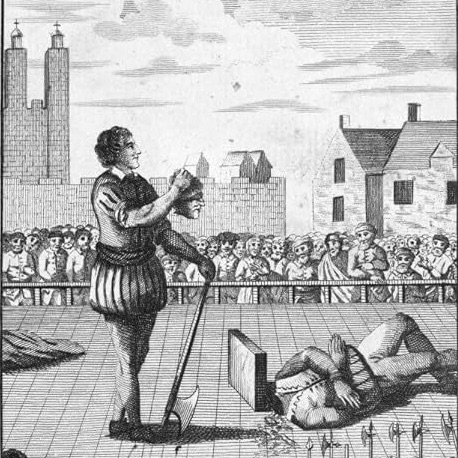
English aristocrat Walter Hungerford, the 1st Baron Hungerford of Heytesbury, was born in 1503 and executed on this day in 1540. Born in Heytesbury, Wiltshire, he was the only child of Sir Edward Hungerford, inheriting Farleigh Hungerford Castle in Somerset in 1522. Appointed as squire of the body to King Henry VIII, he became an ally of Henry’s chief advisor Thomas Cromwell, who arranged for his appointment as sheriff of Wiltshire. His loyalty to Cromwell was rewarded in 1536, when he was styled Lord Hungerford of Heytesbury and entered Parliament. Married twice and with five children, he made a strategic third marriage in 1532 to Elizabeth Hussey, a wealthy heiress and daughter of Baron Hussey of Sleaford. Hungerford’s cruelty towards Elizabeth was well-documented, and she spent several years enduring imprisonment, beatings, starvation and poisoning attempts. In 1536, Elizabeth had a letter smuggled to Cromwell, asking him to bring divorce proceedings on her behalf. She claimed that if Cromwell would not help her, she “may sooner object such matters against [Hungerford] with many other detestable and urgent causes than he can against me, as he well knows”, thought to allude to Hungerford’s homosexuality. Cromwell appears to have disregarded her letter, and Hungerford continued to attend important court events. Cromwell’s downfall made Hungerford an enemy of the state. He was arrested and charged with heresy, treason and sorcery, while the Privy Council investigated his abuse of his wife. He was also accused of committing “unnatural acts” outlawed by the Buggery Act of 1533, a law introduced by Cromwell to allow the easy arrest of priests and the confiscation of Church property for the Crown. According to court records, Hungerford was accused of being “replete with innumerable, detestable and abominable vices and wretchedness of living… and hath accustomably exercised, frequented and used the abominable and detestable vice and sin of buggery with William Master, Thomas Smith and other of his servants.” He was publicly beheaded at Tower Hill in July 1540, aged 36 or 37, becoming the first person sentenced to death under the Buggery Act. Executed on the same day as his patron Cromwell, their severed heads were displayed on spikes on London Bridge. After Hungerford’s death, the happily widowed Elizabeth married Sir Robert Throckmorton, having four children together.
Walter Hungerford, 1st Baron Hungerford

 Super Gays Born on this Day