
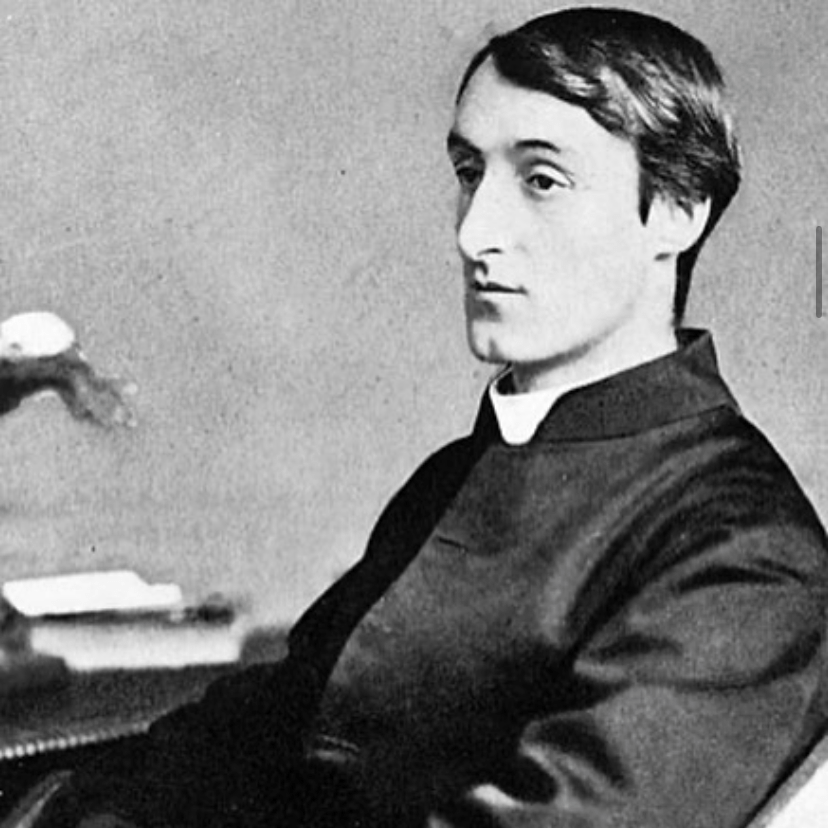
English poet and priest Gerald Manley Hopkins was BOTD in 1844. Born in London to a prominent political and literary family, he was educated at private schools, winning poetry prizes while still in his teams. He studied classics at Oxford University. where he befriended fellow poet Robert Bridges. He fell passionately in love with Bridges’ 17 year-old cousin Digby Mackworth Dolben, cataloguing his erotic fantasies in his journals. Dolben’s accidental death in 1867 had a profound effect on Hopkins, which may well have prompted his decision to convert to Roman Catholicism. He became a Jesuit priest in 1868, burning his poetic compositions and embracing a life of poverty and isolation. He worked variously as a missioner, parish priest and teacher for seven years, composingThe Wreck of the Deutschland in 1875, inspired by the death of five Franciscan nuns in a shipwreck. In 1884, he was appointed professor of Greek literature at University College Dublin, where he composed a sonnet sequence, describing his sense of spiritual and artistic failure. He published almost nothing in his lifetime, believing that it would violate the humility of his religious orders, dying in 1889 aged 44. His work was published posthumously by Bridges, and he became one of the most celebrated poets of the Victorian age, admired for his vivid descriptions of nature and use of an unconventional metre he called “sprung rhythm”. His work had a profound influence on 20th century poetry, notably in the work of W. H. Auden, T. S. Eliot and Dylan Thomas. Biographers and critics have debated the homoerotic subtext of his work, especially the poems The Bugler’s First Communion and Epithalamion.
Gerald Manley Hopkins

 Super Gays Born on this Day