
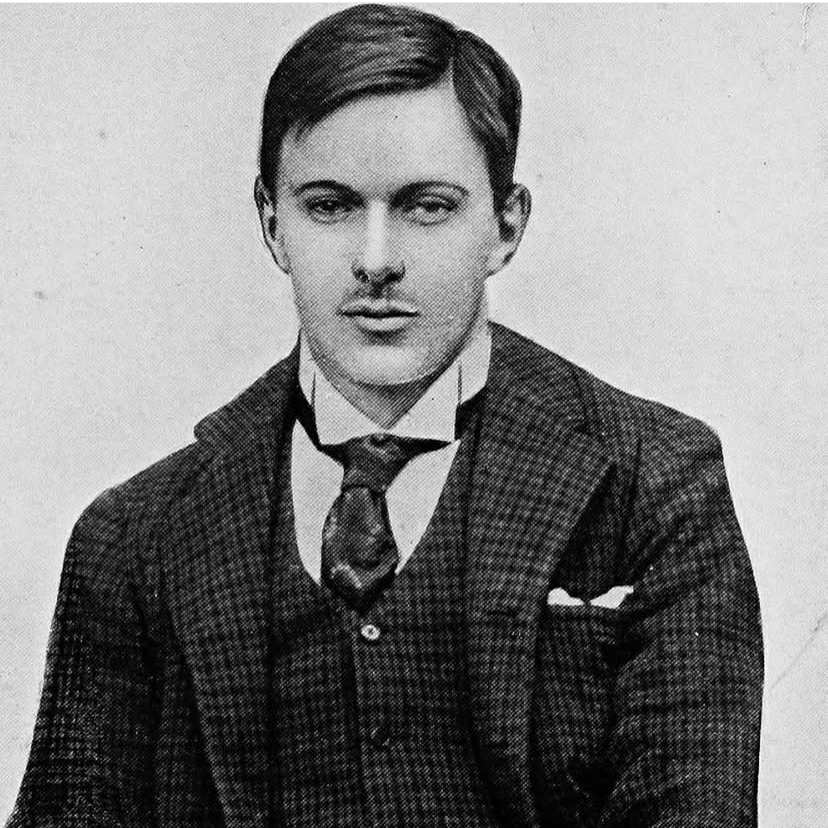
English writer Edward Frederic (E. F.) Benson was BOTD in 1867. Born in Wellington College, Berkshire, his father was the Archbishop of Canterbury. He was educated at Marlborough College and attended Cambridge University, where he fell in love with his classmate Vincent Yorke, writing in his diary “I feel perfectly mad about him just now… Ah, if only he knew, and yet I think he does“. After graduating, he worked for the British School of Archaeology in Athens and later in Egypt for the Society for the Promotion of Hellenic Studies. An accomplished athlete, he also represented England in figure skating (which was very gay, even in Edwardian England). His 1893 debut novel Dodo, a satire about the Bright Young Things of fashionable 1920s London society, was an instant success, catapulting him to literary celebrity and allowing him to write full-time. He repeated his success with his 1896 novel The Babe B.A., based on the antics of his effete Cambridge classmate Herbert Pollitt. He moved to Rye in East Sussex in 1918, living at Lamb House, the former home of Henry James, and served twice as town mayor. Rye became the setting for his successful Mapp and Lucia novel series, chronicling the rivalry between two wealthy women fighting for social supremacy in a seaside town, populated by grotesques including the butch painter Quaint Irene and Lucia’s effete bachelor friend Georgie Pillson. Benson also wrote ghost stories, biographies of Charlotte Brontë, Queen Victoria, William Gladstone and Kaiser Wilhelm II, and two sanitised volumes of memoir. Discreetly gay, he socialised within a largely homosexual circle including Oscar Wilde and Lord Alfred Douglas, and holidayed regularly on the Isle of Capri with his notoriously homosexual friend John Ellingham Brooks. He died in 1940 aged 72. Now considered one of the greatest comic writers of the Edwardian period, his novels have remained continuously in print, and have been adapted for radio and television. The 1985 TV adaptation of the Mapp & Lucia stories, starring Geraldine McEwan, Prunella Scales and Nigel Hawthorne, leaned into the camp and queer codings of Benson’s characters, attracting a devoted gay fanbase.
E. F. Benson

 Super Gays Born on this Day