
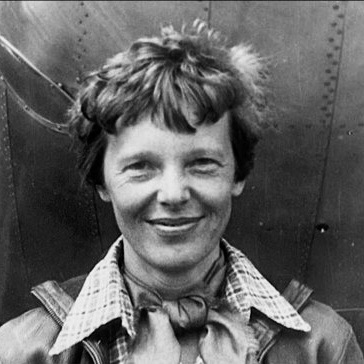
American aviator Amelia Earhart was BOTD in 1897. Born in Atchison, Kansas to a prominent middle-class family, she had a turbulent childhood, marked by her father’s alcoholism, periods of poverty and frequent moving. After her mother received her family inheritance, Amelia was educated at Ogontz School in Rydal, Pennsylvania, though left her studies during World War One to nurse wounded soldiers in Canada. After the war, she moved to New York, intending to study at Colombia University, dropping out in 1920 after her family insisted she lived with them in California. She made her first airplane ride in 1920, quickly taking lessons, buying her first plane and earning her pilot’s licence by 1923. After moving to Boston, she was selected in 1927 to become the first woman to join a solo nonstop flight across the Atlantic Ocean. Tall, athletic and descended from an established Mid-Western family, she was compared favourably to aviator Charles Lindbergh, who had made the same voyage the previous year. Earhart joined the voyage in 1928, piloted by Wilmer Stultz and Louis Gordon, completing the journey in 20 hours 40 minutes. On her return, she became an international celebrity, publishing a bestselling account of her flight and undertaking a national speaking tour. In 1931, she married her press agent George Palmer Putnam, who was largely responsible for crafting her androgynous, all-American persona. Determined to justify her celebrity, Earhart undertook to fly solo nonstop across the Atlantic, which she completed in 1932 in 14 hours 56 minutes. The feat further bolstered her fame, and she became an icon for women’s independence, promoting a clothing line for “the woman who lived actively” and establishing an organisation for female pilots named the Ninety Nines. In 1935, she made history with the first solo flight from Hawaii to California, a hazardous route 500 miles longer than her 1932 Atlantic crossing. Later that year, she became the first person to fly solo from Los Angeles to Mexico City. In 1937, Earhart and her navigator Fred Noonan planned a trip to circumnavigate the world. After a month-long journey covering 22,000 miles, they disappeared around Howland Island in the South Pacific Ocean. Despite an extensive search, their bodies were never recovered, and they were both declared lost at sea, three weeks before Earhart’s 40th birthday. Her letters to her husband describing the trip were published posthumously as Last Flight. Her disappearance added to her status as a cult figure, prompting multiple theories about their escape or capture. While apparently heterosexual, Earhart’s independence, androgynous appearance and fearless challenges to gender norms made her a feminist and lesbian icon. Her life and disappearance inspired numerous novels, plays and documentaries, and she has been played onscreen by Rosalind Russell, Diane Keaton, Amy Adams and Hilary Swank.
Amelia Earhart

 Super Gays Born on this Day