
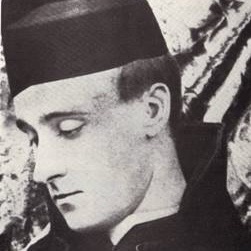
English writer and photographer Frederick Rolfe, also known as Baron Corvo, was BOTD in 1860. Born in London to a working-class family, he left school at 14 and trained as a teacher. Discreetly gay at a time when homosexuality was illegal, he subsumed his attraction to his adolescent male students into homoerotic poetry based on Greek classical myth. After converting to Roman Catholicism in 1886, he was sponsored to study at St Marys College Oscott in Birmingham with the intention of becoming a priest. Sent to Pontifical Scots College in Rome in 1889 to begin his clerical studies, he was dismissed due to poor classroom attendance and erratic (homosexual?) behaviour. Footloose in Rome, he befriended Caroline Shirley, the English-born Duchess Sforza Cesarini, who became his patron and allowed him to use the title Baron Corvo. While living in the Duchess’s palazzo at Genzano di Roma, he began photographing local boys and young men, inspired by the homoerotic photography of Wilhelm von Gloeden. He returned to England in 1890, settling in Dorset where he was supported by a monthly stipend by the Duchess. For reasons that remain unclear, she terminated the arrangement a few months later and had no further contact with him. He made his living as a freelance writer, publishing the homoerotic short story collection Stories Toto Told Me in 1898. He is perhaps best known for his 1904 novel Hadrian the Seventh, in which a failed English priest is taken to Rome and eventually elected Pope. In 1899, he relocated to Venice, where he wrote and researched a series of florid historical novels and socialised with British homosexual expatriates including Horatio Forbes Brown. Like Brown, he developed a taste for adolescent gondoliers, later writing to his friend Charles Masson Fox “My preference was for the 16, 17, 18 and large“. Rolfe also had a passionate, erotically-charged correspondence with the Catholic priest Robert Hugh Benson, at one stage planning to co-author a book about St Thomas Becket. Their relationship ended abruptly in 1906 after Benson decided not to be associated with “a Venetian pimp and procurer of boys”, later satirising Rolfe in his novel The Sentimentalists. Penniless and largely friendless, Rolfe died in Venice in 1913, aged 53. Interest in his life and work was revived after A. J. A. Symons’ 1934 biography The Quest for Corvo. The publication of his Venice letters in 1967 inspired a further revival and a successful 1968 stage adaptation of Hadrian starring Alec McCowen. In 2008, his photographs were collated and published in The Photographs of Frederick Rolfe Baron Corvo 1860–1913.
Frederick Rolfe

 Super Gays Born on this Day