
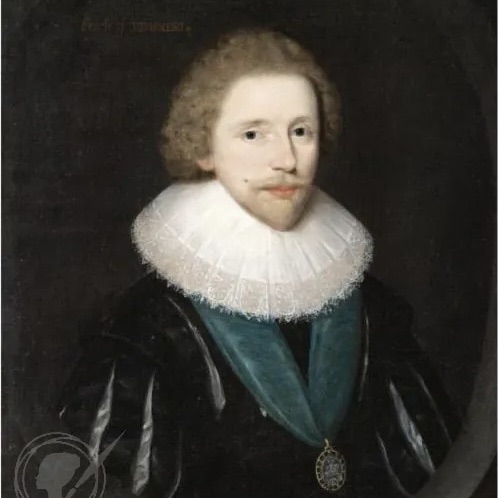
Scottish aristocrat and politician Robert Carr, 1st Earl of Somerset, was BOTD in 1587 and died on this day in 1645. The son of a Scottish nobleman, he attracted the amorous eye of King James I, at the time grieving the break-up of his relationship with George Villiers, Duke of Buckingham. James quickly made Carr a gentleman of the Royal bedchamber, though biographers are divided as to whether they were actually lovers. James knighted Carr, gifting him Sir Walter Raleigh’s former home at Sherborne. While less politically influential than Buckingham, Carr persuaded James to dissolve Parliament in 1610. James raised him to the peerage in 1611, creating him Viscount Rochester, and appointed him to the Privy Council in 1612. On the death of James’ chief minister in 1612, he appointed Carr as his secretary, with the intention of governing himself. James’ inability to attend to state business created a power vacuum, in which Carr and his mentor Sir Thomas Overbury decided to align with the powerful Howard family. Motivated equally by lust and political opportunism, Carr began an affair with Frances Howard, the wife of Robert Devereux, 3rd Earl of Essex. Determined to marry her and consolidated power within the Howard faction, Carr persuaded James to annul the Devereaux’s marriage. Overbury opposed the plans, circulating a pamphlet describing the desired virtues of a wife, which was widely read as an attack on Frances. The Howards pursuaded James to send Overbury to Russia on a diplomatic mission, knowing that if he refused, he would be charged with treason. Overbury duly refused, and was imprisoned in the Tower of London. Carr supported the Howards’ plan, initially on the basis that Overbury would be released after the marriage took place. Frances later plotted, possibly with Carr’s assistance, to have Overbury murdered in prison by poisoning. Overbury died in September 1613, and Carr and Frances were married three months later. Carr was granted an earldom and appointed Lord Chamberlain. His power was short-lived, as the circumstances of Overbury’s death were made public in 1614. Carr and Frances were placed under house arrest, with Frances giving birth to their daughter in 1615. They stood trial in 1616, in a prosecution led by Sirs Francis Bacon and Edward Coke. Frances immediately pled guilty, while Carr steadfastly (if unchivalrously) maintained his innocence. Concerned that Carr would implicate him in the crime, James sent him a series of secret messages during the trial, offering him a pardon if he pled guilty. Both were eventually found guilty, and imprisoned until 1622. Shortly before his death, James granted Carr a pardon in 1624. With his properties and fortune confiscated by the Crown, Carr disappeared from court, reappearing at a Star Chamber hearing in 1630 where he was accused of promoting arbitrary government. After Frances’ death in 1632, he lived in obscurity until his death in 1645, aged 57 or 58. He was played by Laurie Davidson in the 2024 TV drama Mary and George, directed by Oliver Hermanus.
Robert Carr, 1st Earl of Somerset

 Super Gays Born on this Day