
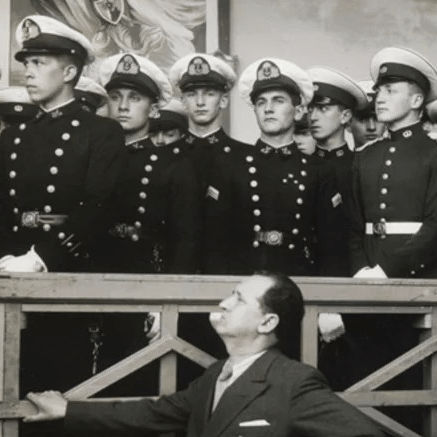
Argentinian socialite and photographer Jorge Ballvé Piñero was BOTD in 1920. Born in Buenos Aires to a wealthy aristocratic family, he was raised in Paris, returning with his family to Argentina in 1931. By his late teens, he was cruising for sex in Buenos Aires’ gay neighbourhoods. Concerned by his use of cocaine and opiates, his family had him institutionalised, where he was subjected to hormone treatment and insulin shock therapy to “cure” his homosexuality. After his release, he lived with his grandparents in central Buenos Aires, renting his own apartment after he came into his inheritance. With a group of queer friends and a token woman used as bait, he began picking up men in the streets, inviting them back to his apartment for bisexual parties and nude photograph sessions. Like many queer aristocrats, he developed a fetish for men in uniform, targeting both working-class sailors and young military cadets from well-to-do-families. After a police investigation, his apartment was raided, revealing thousands of his erotic photographs of young men. Unable to be charged for “corrupting minors” as he was also underage, the police waited until Ballvé Piñero was 22 before arresting him and his cohort. His 1942 trial became a national sensation, bringing the taboo subject of homosexuality into public discourse. Ballvé Piñero and his friends were found guilty, though as the “ringleader” he received the most severe sentence of 12 years’ imprisonment. Over 50 of the military cadets who appeared the photographs were dishonourably discharged, and later ostracised and attacked in public. The trial ignited widespread arrests and persecution of gay men, with many driven into exile (notably the popular Spanish singer Miguel de Molina) or committing suicide. The scandal was later used as an excuse for the 1943 military coup, with the self-proclaimed objectives of “moral sanitation”. Ballvé Piñero served the entirety of his sentence, and was released in 1953. Little is known about his later life, though by the 1970s, he joined the board of his family’s mercantile business. He died in Buenos Aires in 1986 aged 65. Most of his photographs are still classified by the Argentinean government, on the basis that they might cause embarrassment to the subjects’ surviving relatives. Public interest in Ballvé Piñero’s story increased following the publication of Gonzalo Demaría’s 2020 non-fiction book Cacería.
Jorge Ballvé Piñero

 Super Gays Born on this Day