
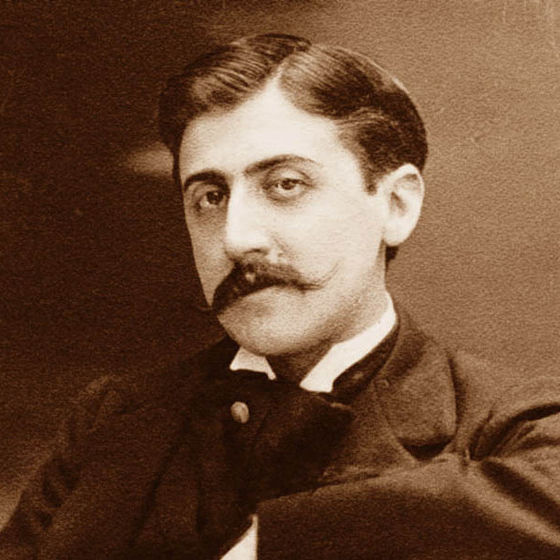
French writer Marcel Proust was BOTD in 1873. Born in Paris to a bourgeois Jewish family, he was an intelligent but sickly child, both chronically asthmatic and allergic to earning his own living. He lived with his parents until their deaths, inheriting a fortune that allowed him to live independently and write full time. A dedicated socialite in his youth, he befriended the leading figures of the Belle Époque, notably the actress Sarah Bernhardt and homosexual aristocrats Robert, Comte de Montesquiou and Edmond de Polignac. He gradually became more reclusive, retreating to a cork-lined bedroom in his apartment on the Boulevard de Hausmann, sleeping during the day and writing at night. His magnum opus, the novel À la recherche de temps perdu (In Search of Lost Time), was written over 13 years. After failing to find a publisher, Proust paid for the publication of the first volume, The Way by Swann’s, in 1913. His theory of “involuntary memory” was demonstrated in a now-famous passage of the Narrator eating a madeleine cake, transporting him back to his childhood in the village of Illiers (renamed Combray). The second volume, In the Shadow of Young Girls in Flower, set at a seaside resort in Normandy, features the teenaged Narrator’s sexual experiences with young working-class women and his unfaithful love interest Albertine. After bribing the judges with expensive dinners, Proust was awarded the Prix Goncourt for Young Girls in Flower, providing legitimacy and an income to finish the project. Volume 3, The Guermentes Way, a vivid, witty portrait of Parisian high society, angered many of his friends including Montesquiou, who was caricatured as the preening homosexual Baron de Charlus. Proust explored his conflicted views of his own homosexuality in volume 4, Sodom and Gomorrah, featuring a scene where Charlus is whipped in a male brothel. Unlike his sexually fluid characters, Proust was exclusively gay, and pursued a number of unhappy relationships with men, including the writer Lucien Daudet and composer Reynaldo Hahn. In 1897, the rampantly gay journalist Jean Lorrain published a newspaper column inferring a romantic relationship between Daudet and Proust. Enraged, Proust challenged Lorrain to a duel, which somehow both men survived. He was also identified by police in a raid on a male brothel in 1918, using his society connections to avoid arrest and public exposure. He died in 1922 aged 51, and was buried in Père Lachaise cemetery in Paris. The remaining three volumes of In Search of Lost Time were published posthumously by his brother, and translated into English by C. K. Scott Moncrieff in 1930. The novel became a landmark in Modernist literature, inspiring writers including Joseph Conrad, William Faulkner, Virginia Woolf, Vladimir Nabokov, Anthony Powell, Iris Murdoch, Tennessee Williams, Truman Capote and Vikram Seth. (James Joyce was less impressed, commenting “I cannot see any special talent”). The sexual coding of Proust’s characters has been extensively analysed by biographers and queer scholars. In his 1999 biography of Proust, Edmund White argued that Albertine and the other unfaithful young women of In Search of Lost Time are stand-ins for Proust’s male lovers, while Albertine is based on Proust’s chauffeur Alfred Agostinelli, on whom he had an unrequited crush. On the centenary of Proust’s birth in 1971, the town of Illiers was renamed Illiers-Combray in his honour. Proust was played by Alan Bates in the 1990 TV drama 102 Boulevard Haussmann, scripted by Alan Bennett, and by Marcello Mazzarella in Raúl Ruiz’s 1999 film Le Temps retrouvé (Time Regained), based on the final volume of À la recherche de temps perdu.
Marcel Proust

 Super Gays Born on this Day