
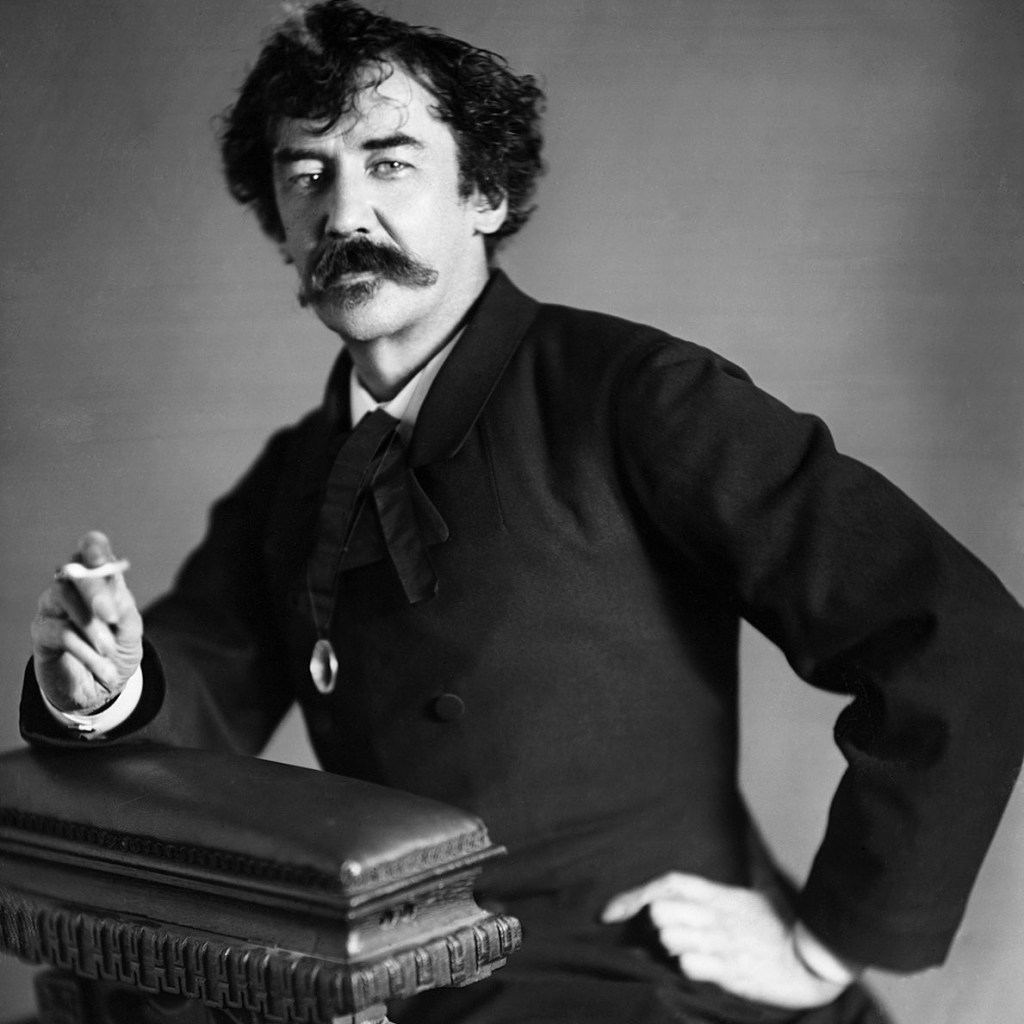
American painter James McNeill Whistler was BOTD in 1834. Born in Lowell, Massachusetts to a prominent middle-class family, he attended the United States Military Academy, before pursuing a career as an artist. He moved to Paris in 1855 to study painting, embracing Bohemian life and allying himself with the realist school French painting. He settled in London in 1863, producing a series of images of the River Thames and befriending Pre-Raphaelite artist Dante Gabriel Rossetti. He achieved major success in Paris with his full-length portrait Symphony in White, No 1: The White Girl, launching a lucrative career as a society painter. He was also widely admired for his nocturnal scenes of London life, notably Cremorne Gardens, No. 2 and Nocturne in Black and Gold, the Falling Rocket. His best known portrait, Arrangement in Grey and Black No. 1, profiles his elderly mother dressed in Victorian mourning black, painted in muted tones against a plain grey background. Sneered at by art critics but adored by the public, it was eventually acquired by the French government. By the 1880s, he was a celebrity in London society, receiving high-profile commissions including the mural series Harmony in Blue and Gold: The Peacock Room for shipping magnate F.R. Leyland. In public, Whistler presented as a dandy with a curled moustache, a monocle and a high-pitched affected drawl. He engaged in a performative feud with fellow aesthete Oscar Wilde, trading witty insults that were frequently reported in the press. Wilde took his revenge by using Whistler as the model for the murdered artist Basil Hallward in The Picture of Doran Gray. Whistler had the last word, publicly condemning Wilde after his exposure as a homosexual and conviction for gross indecency. In 1887, he sued the art critic John Ruskin for libel, winning the case but awarded only a farthing in damages, leading to his declaring bankruptcy. He decamped to Venice, producing a series of highly-admired watercolours, which facilitated his return to London. Despite numerous mistresses and a menagerie of illegitimate children, he socialised with a largely homosexual friendship circle in London and Paris, including Henry James, John Singer Sargent, Marcel Proust and Robert Comte de Montesquiou (whose portrait he painted in 1879), leading to biographical speculation about his potential bisexuality. In 1888, he married Beatrix Godwin, moving together to Paris. His distress at her death in 1896 and the growing popularity of Symbolist and Impressionist art spelled the decline of his painting career, though he became friends with the key figures of both movements, including Stéphane Mallarmé, Édouard Manet, Claude Monet, Edgar Degas, Auguste Rodin and Henri de Toulouse-Lautrec. He died in 1903, aged 69.
James McNeill Whistler

 Super Gays Born on this Day