
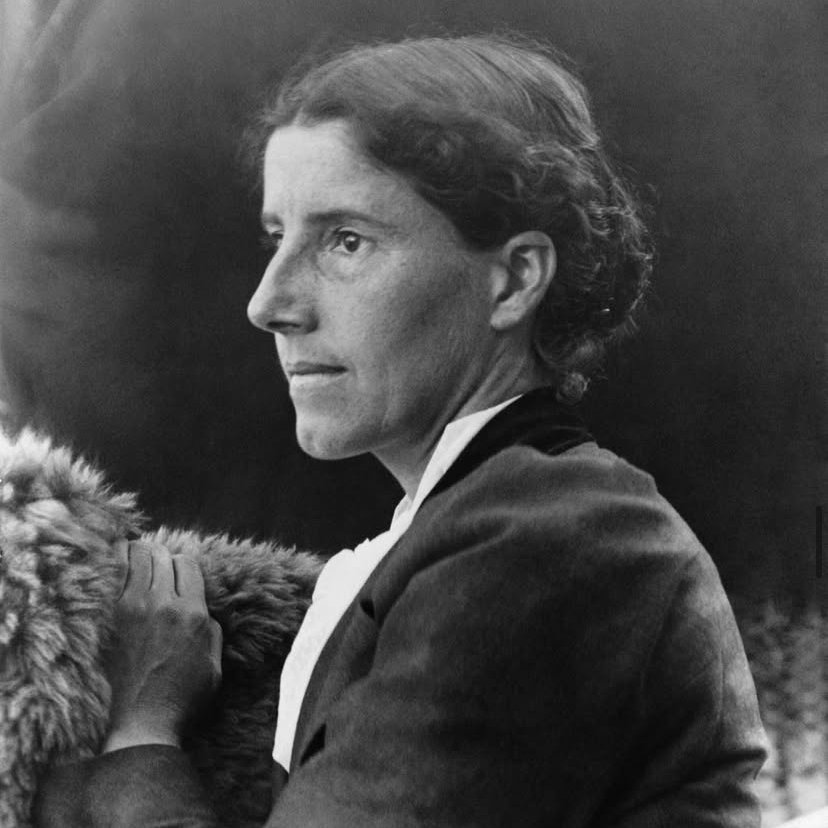
American writer, theorist and activist Charlotte Perkins Gilman was BOTD in 1860. Born in Hartford Connecticut, she grew up in poverty after her father abandoned the family home. After a sporadic education, she enrolled at the Rhode Island School of Design where she had her first lesbian relationship with Martha Luther. In 1884, she married artist Charles Stetson, with whom she had a daughter. Unsuited to the domestic drudgery of marriage, she suffered severe post-natal depression, leading to a nervous breakdown. Sent to California to recuperate, she eventually left Stetson and returned with her daughter to San Francisco, where she had a relationship with journalist Adeline Knapp. She and Stetson divorced in 1894. He remarried soon after to one of Gilman’s close friend. Undeterred, Gilman sent her daughter to live with them, causing a public outrage for her supposed neglect of maternal duty. She began publishing poems and stories in periodicals, turning heads with her story The Yellow Wall-Paper, first published in The New England Magazine in 1892. An extraordinary first-person account of a young wife’s nervous breakdown and confinement. Combining shrewd psychological insight into gender politics with a nightmarish, surrealist intensity, it has since become a classic of feminist literature. Its ambiguous narration and violent climax has been extensively analysed and debated by feminist critics. She became heavily involved in feminist and left-wing politics, undertaking lecture tours throughout the United States and attending the 1896 International Socialist and Labour Congress in London. Like many feminists of her generation, she was also a committed white supremacist, advocating for eugenics and birth control for non-white women. Her 1898 manifesto Women and Economics became an international bestseller, in which she critiqued romanticised notions of women and motherhood and argued for the nationalisation of childcare and domestic service. Her other publications included The Man-Made World, a critique of patriarchal government, and analyses of gender and organised religion. She also edited and published the feminist journal Forerunner, publishing articles and stories by women. In 1900, she returned to New York Cousin and married her cousin Houghton Gilman, remaining together until his death in 1922. After being diagnosed with terminal cancer, she committed suicide in 1935, aged 75.
Charlotte Perkins Gilman

 Super Gays Born on this Day