
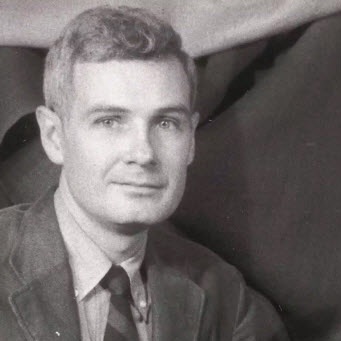
American writer Donald Windham was BOTD in 1920. Born in Atlanta, Georgia to a prominent but impoverished Southern family, he worked for the Coca-Cola factory after leaving school. In 1939, he and his boyfriend moved to New York City. He was hired by Lincoln Kirstein as an assistant on his magazine The Dance Index, becoming editor when Kirstein joined the Army during World War Two. Through Kirstein, he joined a largely homosexual artistic circle including Tennessee Williams, George Platt Lynes, Christopher Isherwood, Glenway Wescott and Paul Cadmus. He and Williams shared an apartment in New York, and collaborated on the play You Touched Me!, based on a D. H. Lawrence story, and first performed on Broadway in 1945. His published his first novel The Dog Star in 1950 and wrote for European literary journals Horizon and The Paris Review. His work attracted a small but elite following, with admirers including E. M. Forster (who wrote an introduction to his short story collection The Warm Country) and Paul Bowles. His 1962 novel Two People, chronicling an affair between a married stockbroker and a 17 year-old boy, horrified pre-Stonewall America, and was a critical and commercial failure. As Williams’ career soared, their friendship soured, not helped by Windham’s 1960 novel The Hero Continues, a satire about a Broadway playwright seduced by success, and the failure of plans for Williams to direct a play of his novel The Starless Air. Windham finally achieved success with his 1964 memoir Emblems of Conduct, an account of his upbringing in Atlanta. In 1977, he published Tennessee Williams’ Letters to Donald Windham 1940-1965, revealing Williams’ sexual promiscuity, apparent plagiarism of Windham’s writing and indiscreet comments about Truman Capote, Gore Vidal and Leonard Bernstein. An instant bestseller, the book made Windham financially independent, but caused a rift with Williams that was never repaired. (The New York Times review described it as “a very damaging book“, stating “if revenge is a dish that tastes best cold, then Donald Windham has certainly fixed himself a satisfying frozen dinner.”) After Williams’ death, Windham published Lost Friendships, describing his relationships with Williams and Capote. He also published his correspondence with Forster and Alice B. Toklas. Windham was in a long-term relationship with Sandy Campbell from 1943 until Campbell’s death in 1988. He died in 2010, aged 89.
Donald Windham

 Super Gays Born on this Day