
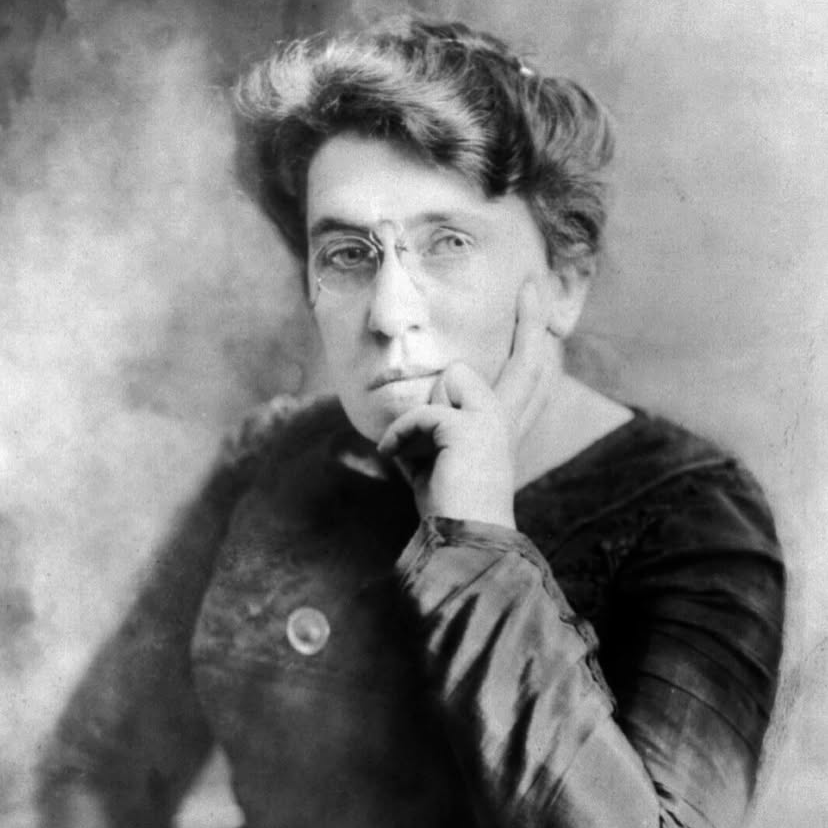
American activist and writer Emma Goldman was BOTD in 1869. Born in Kovno in the Russian Empire (now Kaunas in Lithuania) to an Orthodox Jewish family, she was raised in Königsberg and St Petersburg. She had a limited education, but read widely and associated with a radical left-wing student circle. Rebelling against her family’s expectations that she marry, she immigrated to the United States in 1885, settling in Connecticut and working as a seamstress in clothing factories. After a brief, unsuccessful marriage, she moved to New York in 1889, becoming the lover and colleague of anarchist Alexander Berkman. She became a noted writer and public speaker, advocating for worker’s rights, free love, birth control and a defence of homosexuality, and was imprisoned multiple times for inciting civil disorder. She undertook a lecture tour of the United States and Europe in 1895, increasing her international profile. While lecturing in Glasgow, she married Scottish anarchist James Colton, giving her British citizenship and allowing her to travel more easily in Europe. In 1906, she launched and co-edited the journal Mother Earth, which became a leading publication for the anarchist movement, publishing contributions by Berkman, Ben Reitman, Mabel Dodge, Eva Kotchever, Maxim Gorky, Leo Tolstoy and Margaret Sanger. Repeatedly targeted by the FBI, her naturalisation as an American citizen was revoked in 1908. During World War One, she opposed American involvement and military conscription, and was sentenced to two years’ imprisonment. On her release in 1919, she and Berkman were declared subversive aliens by FBI head J. Edgar Hoover and deported to the Soviet Union. Horrified by the suppression of free speech under Lenin’s new government, she quickly left the country and spent several years in Europe, writing and speaking. Her sustained criticism of the Soviet government placed her at odds with moderate liberals including Bertrand Russell, though she attracted a celebrity fanbase including Edna St Vincent Millay, Theodore Dreiser and Peggy Guggenheim. Somewhat oddly for a Communist anarchist, she spent two years living in Saint-Tropez, working on her memoir Living My Life. Published in 1927, it was praised by critics, and she was granted permission to return to the United States to promote the book. After Berkman’s suicide in 1936, Goldman travelled to Spain to work for anti-Fascist forces in the Spanish Civil War, where she was embraced as a hero. Despite her concerns about the rise of Fascism in Europe, she opposed a war against Germany and Russia, predicting that it would result in “a new form of madness in the world“. At the outbreak of World War Two in 1939, she moved to Canada. She died in 1940, after suffering a series of strokes, aged 70. Despite her reluctance to align herself with the suffragette movement, she was embraced as a hero by second-wave feminists in the 1970s. Now considered one of the central figures in 20th century left-wing politics, she earns Honorary SuperGay status for her embrace of radical causes and sexual freedom. She was played by Maureen Stapleton in the 1981 film Reds, who won an Oscar for the role.
Emma Goldman

 Super Gays Born on this Day