
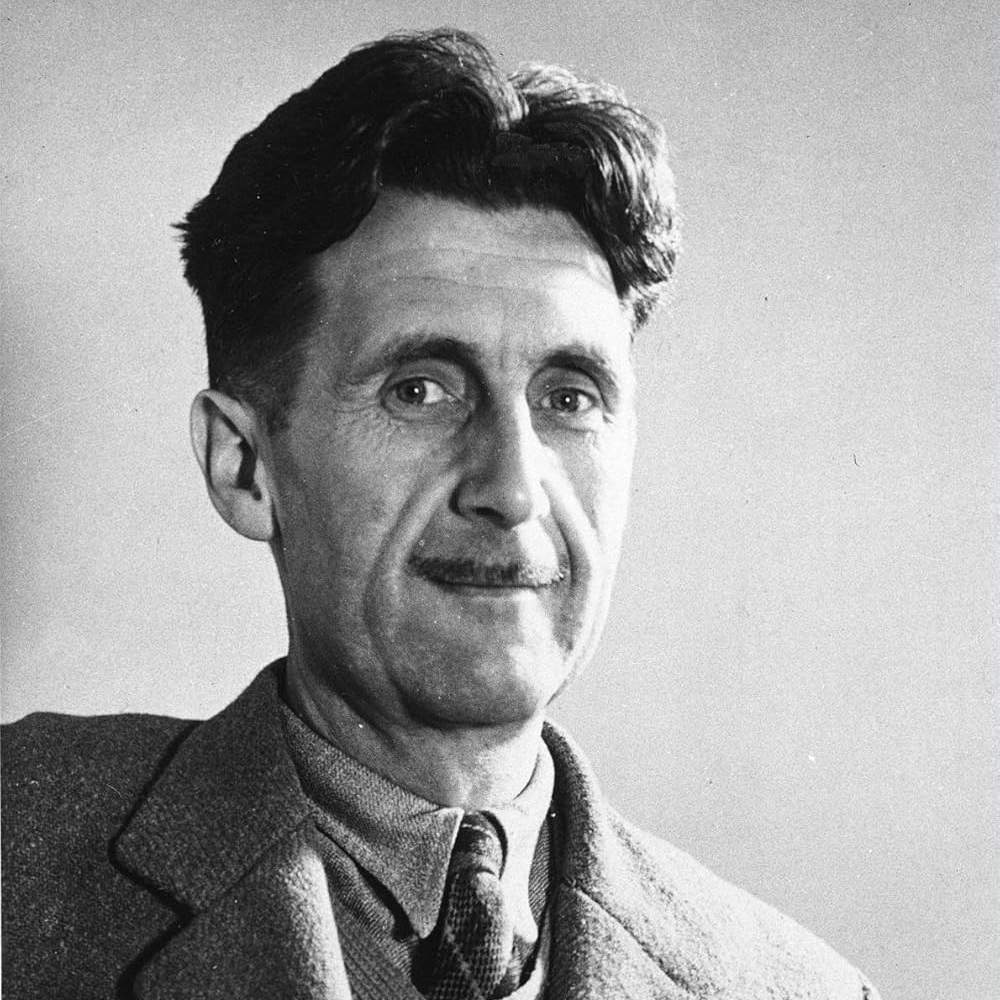
English writer George Orwell was BOTD in 1903. Born Eric Blair in Motihari in British-occupied India, where his father was a colonial administrator, he was sent to England to be educated, winning a scholarship to Eton College. Rather than attending university, he followed his father into the foreign civil service, moving to Burma to work for the Indian Imperial Police. His distaste for British colonialism was expressed in his novel Burmese Days and the biographical sketches Shooting an Elephant and A Hanging. Returning to England in 1927, he lived as a vagrant and menial labourer in London and Paris, chronicling his experiences in his non-fiction novels Down and Out in Paris and London and The Road to Wigan Pier. Consumed with revolutionary fervour (and the beginnings of tuberculosis), he travelled to Spain to support the Republican militia during the Spanish Civil War. After being wounded in battle, he returned to England in 1937, writing about his disenchantment with the Communist cause in Homage to Catalonia. Rejected for military service during World War Two, he worked for the Indian service of the BBC and became literary editor of the left-wing newspaper The Tribune. He finally achieved literary success with his 1945 novel Animal Farm, a story about barnyard animals who overthrow their human masters only to form a brutal animal-ruled dictatorship. Initially marketed as a children’s story, it was quickly recognised as a fable about the corruption of Stalinist Russia, and became a critical and commercial hit. In his 1946 essay Politics and the English Language, Orwell set out his theory of how “ugly and inaccurate” language is used to justify political abuses, advocating for clear and simple language as a tool for combatting tyranny. His ideas were crystallised in his best known work Nineteen Eighty-four, a terrifying portrait of a futuristic Britain ruled by a totalitarian police state, in which rebels are brutally tortured and brainwashed into submission to the regime. Published in 1949, it was an immediate bestseller, interpreted variously as a critique of Socialist and Fascist governments and as a textbook for libertarianism. To date, it has never been out of print, and its title and terminology (including “Big Brother”, “newspeak”, “thought police”, “doublethink” and “thoughtcrime”) have entered the lexicon to describe political distortion of truth and free speech. Orwell married writer Eileen O’Shaughnessy in 1936, adopting a son in 1944, and remaining together until O’Shaughnessy’s death in 1945. He married Sonia Brownell in 1949, dying of tuberculosis in 1950 aged 46. Now recognised as one of the leading political thinkers of the 20th century, the Orwell Prize for political writing was established in his honour in 1994. Orwell’s reputation as a hero of the progressive left was overhauled in Anna Funder’s 2023 biography Wifedom, detailing his mistreatment of O’Shaughnessy, frequent infidelities and erasure of her contributions to his work. Funder also argued that the openly homophobic Orwell may have been bisexual, pointing to his intense friendships with men and disinterest in heterosexual sex.
George Orwell

 Super Gays Born on this Day