
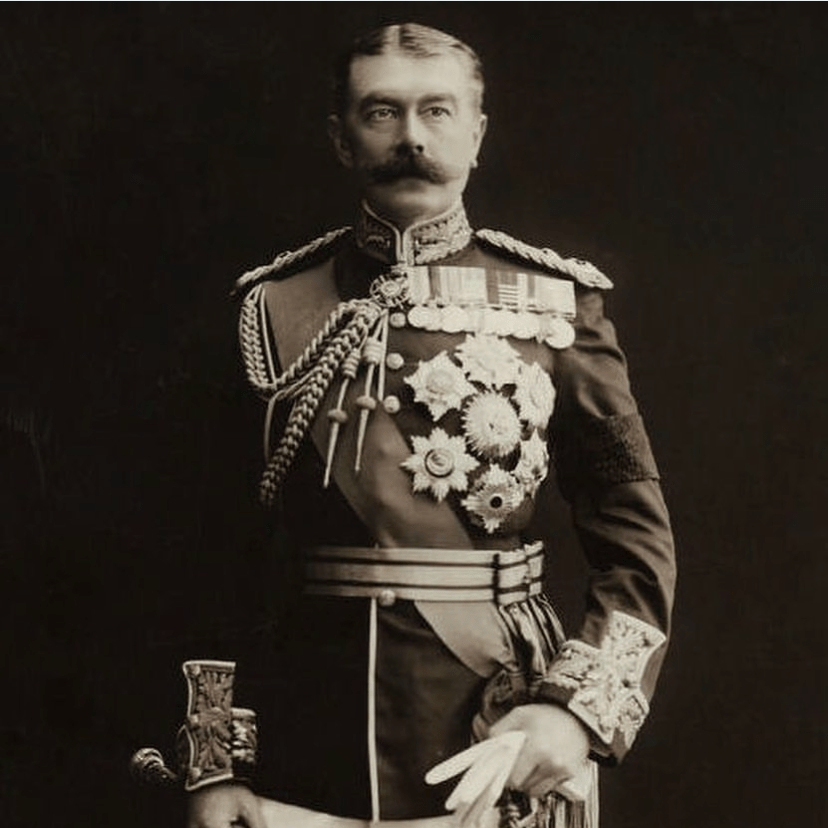
Anglo-Irish soldier and colonial administrator Horatio Herbert Kitchener, latterly the 1st Earl Kitchener, was BOTD in 1850. Born near Listowel in County Kerry, Ireland to a military family, he was raised in Switzerland. After attending the Royal Military Academy in London, he was commissioned in the Royal Engineers corps of the British Army, serving in the Middle East as a surveyor. In 1886, he was appointed governor of the British Red Sea territories and was subsequently appointed adjutant general to British-controlled Egypt. He assumed the commandership of the Egyptian army in 1892, leading a series of brutal military campaigns against Sudanese forces, for which he was created a baron. In 1900, he became commander-in-chief in South Africa, pursuing a scorched earth policy against dissidents during the Second Boer War, burning farms, imprisoning women and children in disease-ridden concentration camps and building blockhouses across the country to isolate rebel forces. Returning to Britain in 1902 a national hero, he was created Viscount Kitchener and appointed commander in chief of India. He reorganised the army to meet possible external aggression rather than internal rebellion, putting him at odds with the viceroy Lord Curzon. The British government eventually backed Kitchener, leading to Curzon’s resignation. Kitchener remained in India until 1909 though failed to secure the role of viceroy. In 1911, he was appointed proconsul of Egypt and the Sudan, effectively ruling both countries until the outbreak of World War One. Reluctantly appointed British Secretary of State for War, he correctly predicted a long and bloody battle. He quickly organised a large volunteer army via a successful recruitment campaign, featuring an image of his face with the slogan “Your Country Needs You”. Criticised for his mismanagement of the army and blamed for a shortage of ammunition, he was eventually stripped of his control over munitions and military strategy. In 1916, he boarded the HMS Hampshire to attend peace negotiations with Russian Tzar Nicholas II. He drowned en route when the ship struck a German mine off the coast of Orkney. He was 65. His death prompted national mourning in Britain, and a memorial was installed in his honour in St Paul’s Cathedral. Long considered a national hero, his name has become synonymous with British imperial warmongering and military incompetence. A lifelong bachelor, Kitchener’s sexuality has been extensively debated by historians and biographers, particularly his friendship with his “constant and inseparable companion” Captain Oswald Fitzgerald.
Lord Kitchener

 Super Gays Born on this Day