
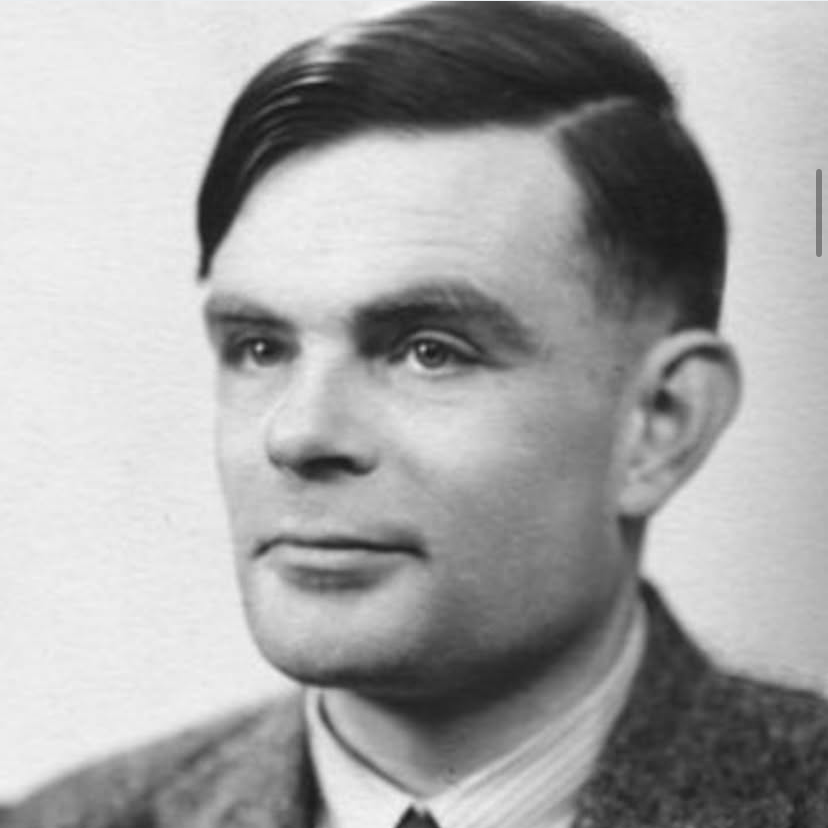
English mathematician and theorist Alan Turing was BOTD in 1912. Born in London to an upper middle class family, he was educated at private schools and studied mathematics at Cambridge University. He became a fellow of King’s College in 1934 in recognition of his research in probability theory. In 1936, he published the first of a series of papers setting out early theories of computer science, leading to post-graduate study at Princeton University. He returned to England in 1928 at the outbreak of World War Two and worked for British intelligence to de-encrypt enemy messages. He played a crucial role in deciphering the Enigma code, credited as a key step in the Allied forces’ victory over Nazi Germany, for which he was awarded the Order of the British Empire. After the war, he was recruited to the National Physical Laboratory to create an electronic computer, based on his earlier theories of a “Turing machine”. He also developed early theories of artificial intelligence, developing the “Turing test” to determine whether a computer can replicate human thought. Discreetly gay, he started a relationship with 19 year-old Alfred Murray in 1952. Following a police investigation, he and Murray were charged with gross indecency. Turing pled guilty and accepted probation with chemical castration instead of prison, enabling him to keep working. He died in 1954 of cyanide poisoning, which was assumed to be suicide. He was 41. In 2009, Prime Minister Gordon Brown issued a public apology for Turing’s treatment. Four years later, Queen Elizabeth II granted Turing a posthumous pardon. In 2017, the UK government passed the “Turing Law”, pardoning all past convictions for gross indecency. Now considered one of Britain’s most prominent LGBTQ heroes, his life and work has been recognised in a series of tributes, including (as of 2021) appearing on the Bank of England’s £50 banknote.
Alan Turing

 Super Gays Born on this Day