
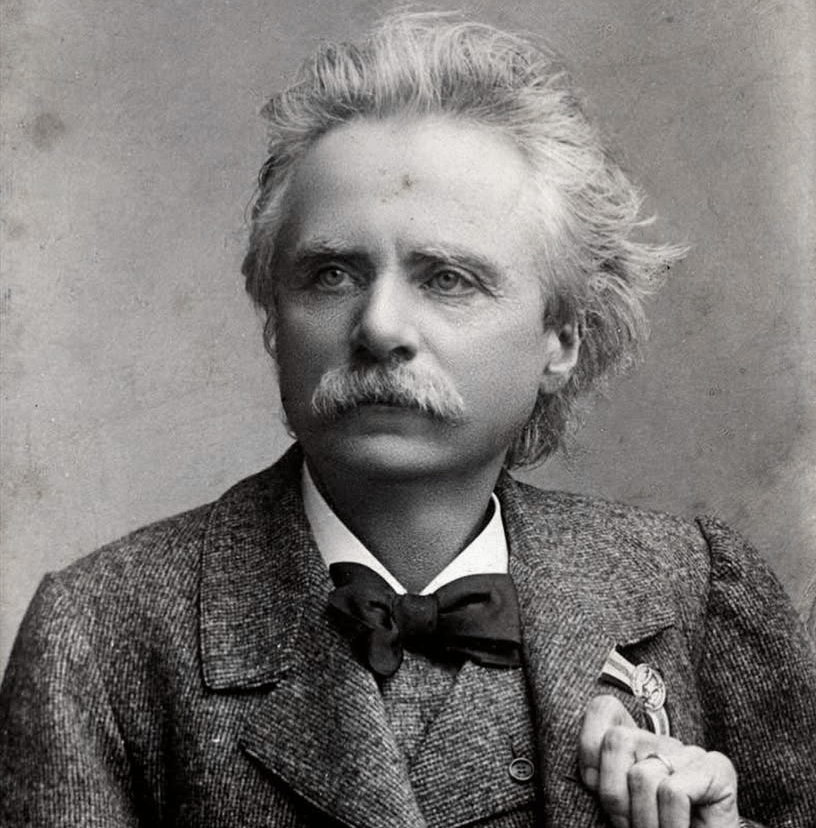
Norwegian composer and musician Edvard Grieg was BOTD in 1843. Born in Bergen to a socially prominent family, he showed an early talent for music, and was accepted to the Leipzig Conservatory when he was 15. In 1863, he visited Denmark, forming a close friendship with the Norwegian composer Rikard Nordraak, who encouraged his interest in Scandinavian music. Bereft after Nordraak’s early death in 1866, he composed a Funeral March in his honour. The following year, Grieg married his first cousin, the opera singer Nina Hager, settling in Christiania (now Oslo). Following Nordraak’s influence, he composed ten collections of folk-inspired piano pieces over the next twenty years (published collectively as Lyriske Stykker in 1901). His international reputation was bolstered after meeting celebrity pianist-composer Franz Liszt in 1870, whose performance of Grieg’s Piano Concerto became an instant success. During the 1870s, he befriended Norwegian poet Bjørnstjerne Bjørnson, setting several of his poems to music, famously falling out when Grieg began collaborating with playwright Henrik Ibsen. In 1874, he was granted an annual stipend by the Norwegian government, enabling him to compose full time. Grieg’s musical composition Peer Gynt, written to accompany Ibsen’s play of the same name, premiered in 1876, and became his most performed composition, notably Morning Mood, a musical depiction of sunrise, and the dramatic piece In the Hall of the Mountain King. Hailed as Norway’s national composer, his work was credited with helping develop a coherent national identity. Despite ill health, he undertook a series of successful tours throughout Scandinavia, Western Europe and England, attracting celebrity fans including Pyotr Ilyich Tchaikovsky and Queen Victoria. Another admirer was Australian-born composer Percy Grainger, with whom he was rumoured to have an affair. (“I love him like I love a young woman”, Grieg was quoted as saying, after meeting Grainger in 1906). Grieg died in 1907, aged 64. His funeral attracted tens of thousands of mourners, and his ashes were buried in a mountain crypt near his house. Among many posthumous tributes, Bergen’s concert hall and music school were named in his honour.
Edvard Grieg

 Super Gays Born on this Day