
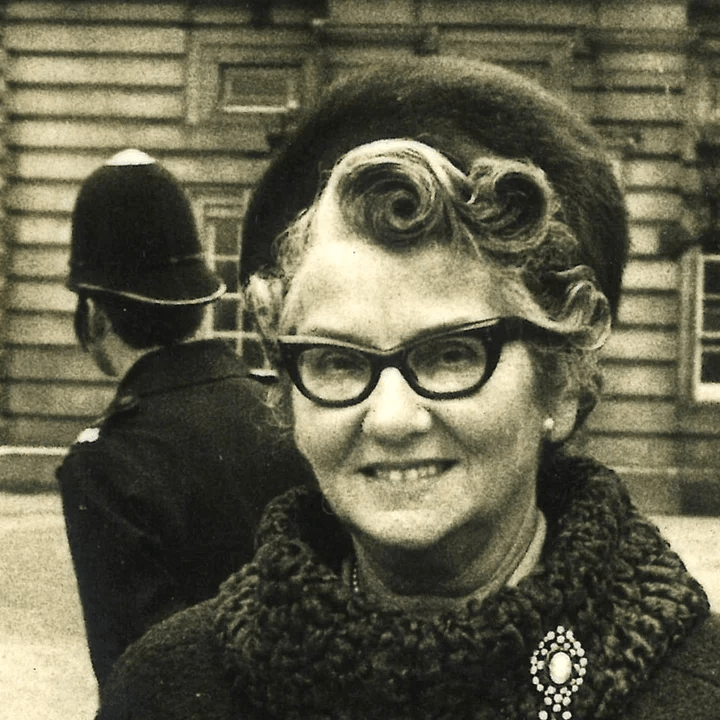
English morals campaigner Mary Whitehouse was BOTD in 1910. Born in Nuneaton, Warwickshire to a lower-middle-class family, she trained as an art teacher. In 1925, she joined the Wolverhampton branch of Christian fellowship Oxford Group, later renamed the Moral Re-Armament Group. She married fellow MRA member Ernest Whitehouse in 1940, with whom she had five children, two dying in infancy. She became senior mistress of a girls’ secondary school in Shropshire. During the Profumo Affair in 1963, she was horrified at witnessing her pupils mimicking sexual intercourse, prompted by a television programme about Christine Keeler and Mandy Rice-Davies. Determined to rid post-war British society of “filth”, she gave up teaching to become a full-time activist, launching the Clean Up TV Campaign and later the National Viewers’ and Listeners’ Association. For the next 50 years, she led a series of letter-writing against the BBC, criticising the use of swearing in TV sitcoms, sexual references (notably Chuck Berry’s song My Ding-a-Ling) and depictions of sex and violence. Branded a “fascist” by journalist Johnny Speight, she sued the BBC for libel, winning a full apology and significant damages, earning the lifelong hatred of BBC Director-General Sir Hugh Greene (who reportedly threw darts at a photo of her to vent his frustration). In 1976, she brought a private prosecution against Gay News magazine for its publication of James Kirkup’s poem The Love That Dares to Speak Its Name, in which a Roman centurion expresses sexual desire for the crucified Jesus. Whitehouse argued successfully that the poem breached blasphemy laws, again winning substantial damages. Less successful was her suit against the National Theatre’s production of Howard Brenton’s play The Romans in Britain (which she had not seen), depicting Roman soldiers anally raping a Celtic druid. She was made a Commander of the British Empire in 1980 by close friend Margaret Thatcher, who shared her restrictive views about pornography, though failed to help her secure a ban on sex toys. By the late 1980s, Whitehouse’s moral crusading was a common target of satire, notably in the BBC comedy show The Mary Whitehouse Experience. She published a memoir, Quite Contrary, in 1994, and remained happily married until her husband’s death in 2000. Mary died in 2001 aged 91, sadly missing the opportunity to protest about internet porn. She was played, a little too kindly, by Julie Walters in the 2008 TV drama Filth: The Mary Whitehouse Story.
Mary Whitehouse

 Super Gays Born on this Day