
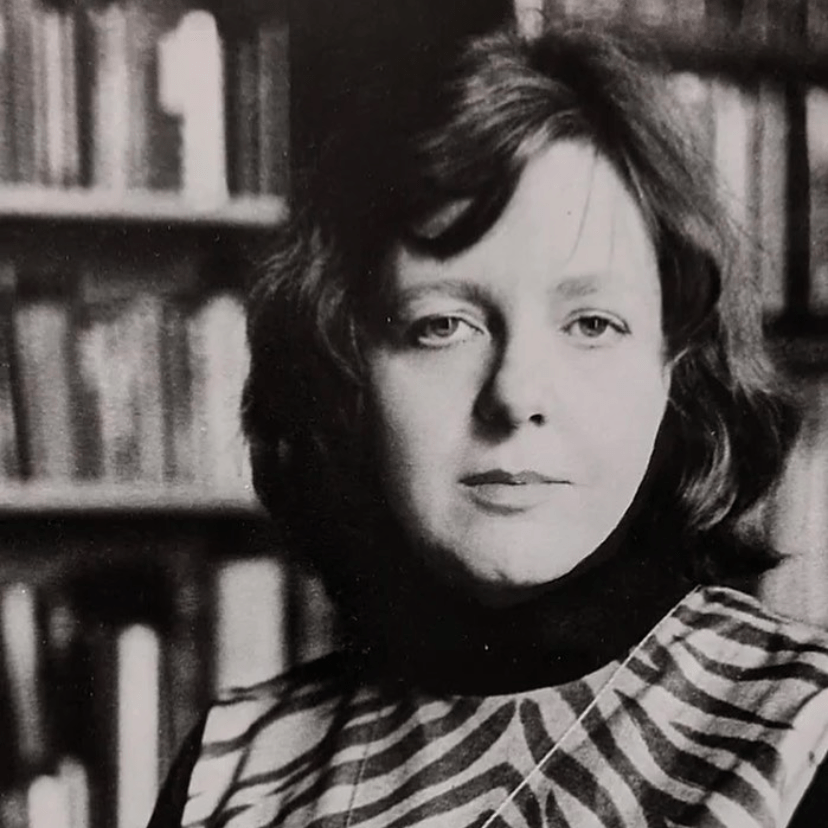
English writer Brigid Brophy was BOTD in 1929. Born in London to a prominent literary family, she began writing at an early age. Educated at private schools, she studied at Oxford University but left without completing a degree. She published her first novel, Hackenfeller’s Ape, in 1953, which won first prize at the Cheltenham Literary Festival. The runner-up writer, Iris Murdoch, became Brophy’s lifelong friend and lover. In 1954, Brophy married the art historian Michael Levey, with whom she had a daughter. They had an open marriage, allowing Brophy to continue her relationship with Murdoch. In 1967, Brophy and Levey caused a sensation with Fifty Works of English and American Literature We Could Do Without, co-written with literary critic Charles Osborne, attacking eminent literary figures and trashing classic texts including Hamlet and Huckleberry Finn. She also wrote critical portraits of Mozart, Aubrey Beardsley and Ronald Firbank. Her 1962 non-fiction treatise Black Ship to Hell, examined humanity’s instincts towards self-destruction, becoming her unofficial personal manifesto. During the 1970s, she published a series of comic novels exploring the psychology of sex and modern relationships, including In Transit, about a genderless character living in an airport lounge; The Snow Ball, a black comedy about party-goers who dress as characters from Mozart’s Don Giovanni; The Finishing Touch, a lesbian retelling of Muriel Spark‘s The Prime of Miss Jean Brodie; and Palace Without Chairs, a fantasy set in a mythical modern kingdom. She also wrote a series of children’s books, based on Edward Lear’s The Owl and the Pussycat, and had a play produced in the West End. During the 1970s, she campaigned successfully for the re-introduction of Public Lending Right, whereby authors receive a payment every time their books were borrowed from public libraries. Diagnosed with multiple sclerosis when she was 54, she wrote about physical and psychological effects of the disease in a collection of essays, published as Baroque ‘n’ Roll in 1987. After being cared for by her husband for many years, she moved to a nursing home in Lincolnshire. She died in 1995 aged 66.
Brigid Brophy

 Super Gays Born on this Day