
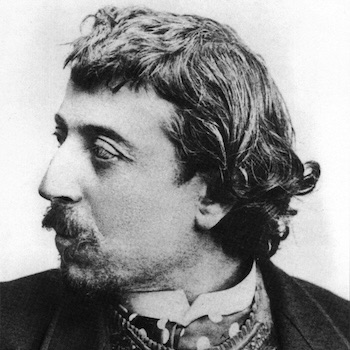
French painter Eugène Henri Paul Gauguin was BOTD in 1848. Born in Paris to a French father and a French-Peruvian mother, his family travelled to Peru shortly after his birth to escape the carnage of the 1848 Paris Revolution. His father died on route, and his mother took the family to her uncle’s estate in Lima, returning to France in 1852. At age 17, Gauguin joined the Merchant Marines, travelling the world for six years. After his mother’s death in 1867, he returned to Paris and became a stockbroker, marrying and starting a family. He became interested in art, collecting works by the Impressionist painters, eventually studying with Camille Pisarro and Paul Cézanne. The stock market crash of 1882 made him unemployed, and he dedicated his life to painting, showing his work at the Impressionist exhibition of 1886. The following year, he travelled to French-controlled Martinique, where he adopted a “primitivist” style in his work, inspired by his Peruvian ancestry and the island’s tropical landscape. Returning to France, he befriended art dealer Theo and Vincent van Gogh, staying with the latter in Arles during the winter of 1888. They developed an intense, erotically-charged friendship, influencing each other’s work while disagreeing about the purpose of art. Two months into Gauguin’s stay, they had a violent argument, possibly ignited by Gauguin rejecting van Gogh’s romantic advances, resulting in Gauguin mutilating van Gogh’s ear with a sword. (Biographers have since speculated that the story about Van Gogh self-mutilating his ear was invented to spare Gauguin’s reputation). After several years living in Paris and Brittany, Gauguin emigrated to Tahiti in 1891. Attempting to shake off Western art traditions, he produced vividly coloured landscapes, copying Polynesian sculpture and art forms, and painting highly eroticised portraits of his teenaged Tahitian mistresses and adolescent boys. He also developed an erotic fascination with the mahu (indigenous Tahitians embodying a third gender), painting them frequently in his work. On his return to France in 1893, he published an illustrated book of his impressions of Tahiti, including descriptions of erotically-charged encounters with adolescent boys. Returning to Tahiti, he settled on the island of Hiva Oa, dying in 1903 aged 54. Now recognised as one of the major artists of the Post-Impressionist and Symbolist periods, Gauguin’s legacy is complicated by his abusive treatment of his lovers, his eroticisation of his adolescent subjects and his colonialist depictions of indigenous people. His bisexuality and pederastic desires were largely ignored by historians and biographers until Nancy Mowell Matthews’ 2001 biography Paul Gauguin: An Erotic Life. He has been played onscreen by Anthony Quinn, Donald and Kiefer Sutherland, Wladimir Yordanoff and Oscar Isaac, and his life inspired Federico Elizalde’s 1943 opera Paul Gauguin.
Paul Gauguin

 Super Gays Born on this Day