
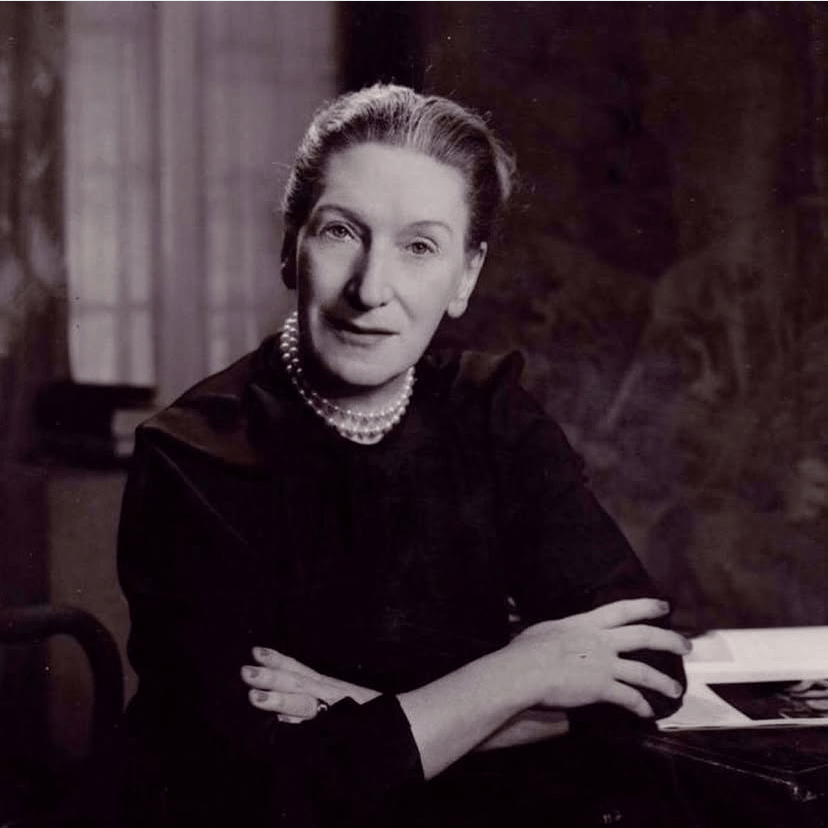
Anglo-Irish aristocrat and writer Elizabeth Bowen was BOTD in 1899. Born in Dublin, Ireland to an aristocratic family, she grew up in her family’s ancestral home, Bowen’s Court. When she was seven, she was raised in England after her father was committed to a mental asylum. Orphaned at 12, she was raised by aunts, moving to London in her late teens to study art. Realising that her talents lay in writing, she began publishing short stories. A shadow member of the Bloomsbury Group, she had a tricky, rivalrous friendship with Virginia Woolf, who later described her as “a very honourable, horse-faced hard constricted mind”. In 1923, Bowen’s first novel Encounters was published, and she entered into a marriage of convenience with Alan Cameron. Unlike Woolf and the modernists, Largely ignoring the experimentation of Modernist writers, her work focused on emotional turmoil among the repressed upper-middle-classes, with baroque and cryptic prose style reminiscent of Henry James. She rose to public attention with 1935’s The House in Paris, a story of love and betrayal told through the eyes of two children. During World War Two, Bowen worked for the Ministry of Information and served as an air raid warden, which inspired her best-known works The Death of the Heart and The Heat of the Day, praised for their evocation of London during the Blitz. Bowen had a number of affairs with men and women, including writers May Sarton and Seán Ó Faoláin and a long-term relationship with Canadian diplomat Charles Ritchie. In 1930, she inherited Bowen’s Court, and retired there in the early 1950s, where she hosted literary salons, with guests including Woolf, Eudora Welty, Sylvia Plath, Carson McCullers and Iris Murdoch). Unable to afford playing Lady of the Manor, she sold Bowen’s Court in 1959, which was demolished the following year. Her final novel Eva Trout was shortlisted for the 1970 Booker Prize. She died in 1973 of cancer, aged 73.
Elizabeth Bowen

 Super Gays Born on this Day