
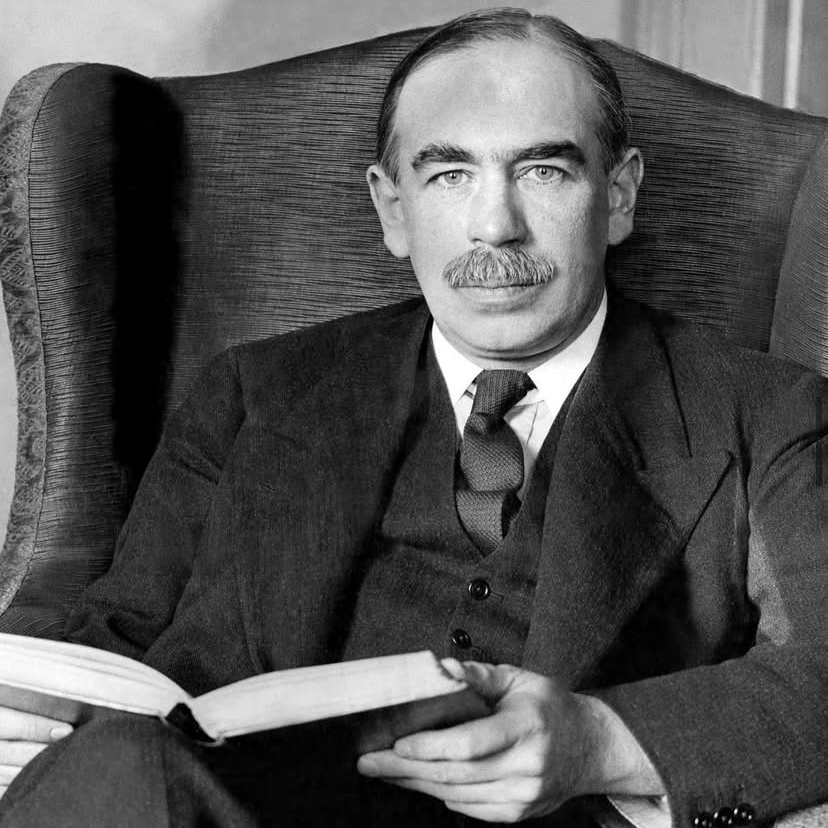
English economist John Maynard Keynes was BOTD in 1883. Born in Cambridge to a prosperous upper-middle-class family, he was educated at Eton College, where he affairs with many of his fellow students, carefully recording his experiences in his diary. He attended Cambridge University, intending to study mathematics but shifting his focus to politics and economics. He had an affair with fellow student Lytton Strachey, who introduced him to members of the Bloomsbury Group, befriending Leonard and Virginia Woolf, art critic Clive Bell and the painter Duncan Grant, with whom he had an extended affair. After graduating in 1909, he became a civil servant, working in the India division of the Foreign Office and advised on the British government’s credit arrangements during World War One. In 1919, he accompanied prime minister David Lloyd George to France to assist with peace treaty negotiations. Concerned over the punitive policies imposed on the defeated Germany, he resigned from government, publishing an indictment of the Versailles peace treaty in which he cannily predicted the impending “devastation of Europe”. He spent the 1920s writing and lecturing on economic theory, and supported the British government’s programmes of public works during the Great Depression. A prominent supporter of women’s rights and birth control education, he also advocated for a repeal of laws against homosexuality. During the 1930s, he led a substantial change in British economic policy, advocating for a government-sponsored policy of full employment to remedy economic recession. His theories, published in his 1936 book The General Theory of Employment, Interest and Money, became known as “Keynesian” economics. He continued advising the British government during World War Two, helping negotiate a multi-billion-dollar loan from the United States to Britain in 1945. Though predominantly homosexual, he surprised his friendship circle by marrying Russian ballerina Lydia Lopokova in 1925. The couple had no children, but appear to have lived together happily until Keynes’ death in 1946, aged 62. His economic theories of government intervention enjoyed regular surges in popularity throughout the 20th and 21st century, notably following the 2007 Global Financial Crisis and the COVID-19 pandemic.
John Maynard Keynes

 Super Gays Born on this Day