
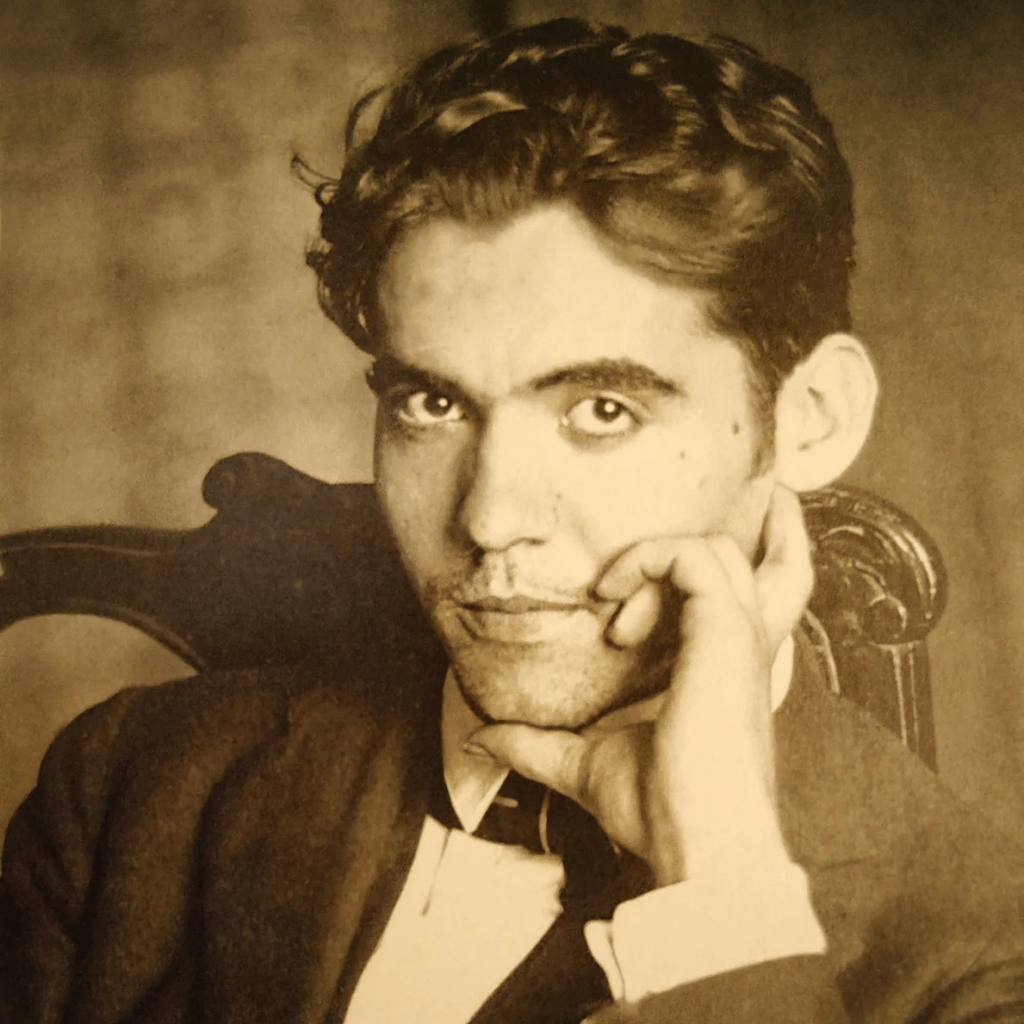
Spanish poet and playwright Federico García Lorca was BOTD in 1898. Born in Fuente Vaqueros in Andalucia to a prosperous landowning family, he studied at the University of Granada, taking nine years to complete his degree. He began writing in his teens, publishing his first book Impresiones y paisajes (Impressions and Landscapes) in 1918. He moved to Madrid the following year, living for the next decade in a men’s residence hall where he befriended Luis Buñuel and Salvador Dalí. His early plays were met with harsh criticism, though he had more success with recitations of his own work, drawing a cult following for his high-energy performances. In the 1920s, he began experimenting with short, elliptical verse forms inspired by Spanish folk song and Japanese haiku. Encouraged by Dalí (with whom he had a complex, erotically-charged friendship), his work became more surrealist and experimental, and he became a central figure in the “Generation of 27”. He shot to national celebrity with the publication of Romancero gitano (Gypsy Ballads) in 1928, though struggled with fame, ending his friendship with Dalí after the release of Dalí’s short film Un chien andalou, which he read as a personal attack. He visited New York and Cuba in 1929 which rejuvenated his work, publishing work inspired by American poets Walt Whitman, T. S. Eliot and Stephen Crane. Returning to Spain, he managed a student theatre group and achieved international success with his trilogy of Andalusian-set tragedies Bodas de sangre (Blood Wedding), Yerma and La casa de Bernarda Alba (The House of Bernarda Alba). His poetry series Sonetos del amor oscuro, written in 1935 though unpublished in his lifetime, recalled a failed love affair with Rafael Rodríguez Rapún. Lorca’s left-wing views and homosexuality made him an enemy of the Fascist government. He was arrested and executed by the Nationalist militia in 1936, aged 38. His body has never been found. One of literature’s most revered writers, his plays are regularly performed around the world.
Federico García Lorca

 Super Gays Born on this Day