
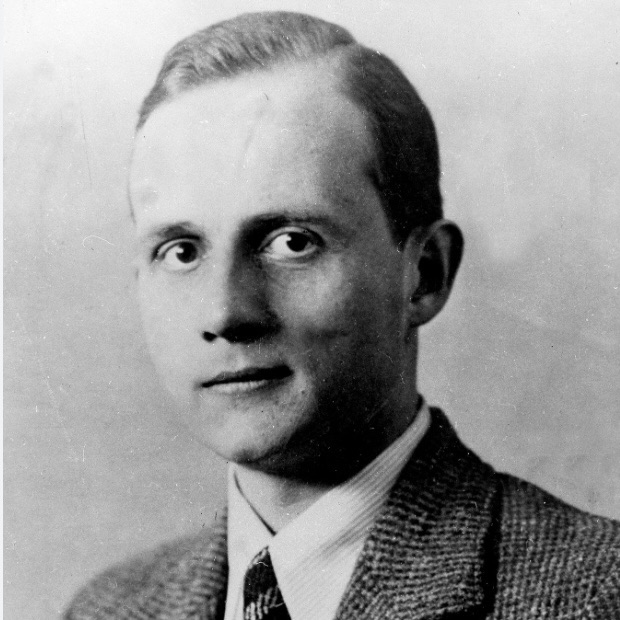
German aristocrat, diplomat and Nazi Ernst vom Rath was BOTD in 1909. Born in Frankfurt to an aristocratic family, he attended school in Breslau and studied law at Bonn, Munich and Königsberg. In 1932, he joined the Nazi Party and later joined the Sturmabteilung (Storm Troopers), the party’s paramilitary force. He worked as a diplomat for the Party, with postings in Bucharest and Paris. In November 1938, he was shot at his Paris office by Hershel Grynszpan, a 17 year-old German Jewish man seeking information about the deportation of his parents to Poland. Rath died of his wounds two days later, despite the intervention of Adolf Hitler’s personal surgeons. He was 29. Hours before his death, Hitler promoted him to the rank of Legation Counsellor, First Class. Rath received a state funeral in Düsseldorf, attended by Hitler and Foreign Minister Joachim von Ribbentrop. In his eulogy, Ribbentrop described vom Rath’s killing as an attack by Jews on the German people. That evening, Propaganda Minister Joseph Goebbels made an inflammatory speech at a beer hall in Munich, inciting German citizens to take the law into their own hands and attack Jewish homes, businesses and community centres. Within hours Sturmabteilung and Schutzstaffel (SS) forces launched a widespread attack on Jewish communities throughout Germany and Nazi-occupied Austria and Czechoslovakia, which became known as Kristallnacht (Night of Broken Glass, causing property damage of over a billion Reichmarks (US $8.93 billion in modern currency). Over 90 Jewish citizens were killed, with a further 30,000 arrested and sent to concentration camps. Grynszpan was immediately arrested after the killing and confessed to murder, insisting that his motives were to avenge the Jewish people against Nazi occupation and brutality. Within days of the killing, rumours began circulating that Grynszpan had met vom Rath at a gay bar in Paris and that they were lovers. Historians have since debated whether Grynszpan himself invented the story as a line of defence, or if he had posed as gay to win vom Rath’s affections and help secure his parents’ release. After two years in prison awaiting trial, Grynszpan was extradited to Germany in 1940 and imprisoned by the Gestapo, while Goebbels planned a show trial to prove an international Jewish conspiracy to murder vom Rath. The trial was postponed, thought to be due to Hitler’s and Goebbels’ fears of public embarrassment about a Nazi diplomat having a sexual relationship with a Jewish man. Grynszpan was returned to Sachsenhausen concentration camp outside Berlin. He is thought to have died, possibly via execution, at Sachsenhausen in 1942, though a photograph taken at a Bavarian refugee camp in 1946 suggests he may have survived. In 1952, German journalist and Nazi sympathiser Michael von Soltikow published a series of articles claiming that Grynszpan was alive and living in Paris and repeated the story about his and vom Rath being lovers; vom Rath’s surviving family. subsequently sued him for defamation. In 2001, historian Hans-Jürgen Döscher claimed that vom Rath was well known in Paris’ gay community and was nicknamed “Frau Botschafterin (Mrs Ambassador)” and “Notre-Dame de Paris” due to his enthusiasm for sex. The killing of vom Rath and the subsequent events of Kristallnacht inspired Michael Tippett‘s 1952 oratorio A Child of Our Time.
Ernst vom Rath

 Super Gays Born on this Day