
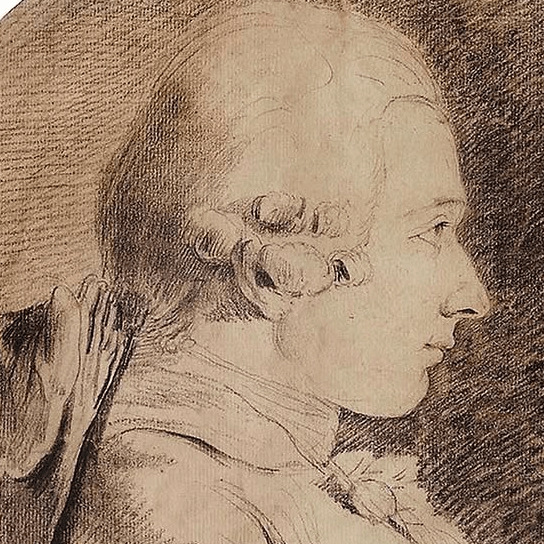
French aristocrat and writer Donatien Alphonse François, the Marquis de Sade, was BOTD in 1740. Born in Paris to the royal house of Condé, he was schooled by his uncle before studying at the Lycée Louis-le-Grand. He began a military career in 1754, which he abandoned at the end of the Seven Years’ War. In 1763, he married Renée-Pélagie Cordier de Launay, the daughter of a high-ranking bourgeois family, with whom he had two sons. Over the next decade, he was involved in a series of sex scandals, typically involving his imprisonment and brutal torture of prostitutes, often procured by his manservant Latour (with whom he also had a sexual relationship). Imprisoned multiple times, he lived as a fugitive for many years in Italy. On his return to Paris in 1777, he was imprisoned at Vincennes and later in the Bastille, where he began writing The 120 Days of Sodom, an erotic text celebrating his fantasies of rape, donination, torture and sodomy. After the French Revolution, he was transferred to the insane asylum at Charenton and eventually released in 1790. He served briefly as a hospital inspector for Robespierre’s government, narrowly escaping the guillotine during the Reign of Terror. The publication of his novels Justine and Juliette led to his arrest and imprisonment in 1801. Declared insane in 1803, he was imprisoned permanently at Charenton on the orders of Napoleon. He was permitted to write in prison and frequently staged his plays as public entertainment, using inmates as actors. Repeatedly denied parole, he remained in prison until his death in 1814, aged 74. His work remained banned in France until the mid-20th century, though illegal copies were read by many Modernist writers, notably Guillaume Apollinaire, who argued for Sade’s importance as a moralist and philosopher. As censorship laws were relaxed in the 1960s, his works were republished and translated. He became championed by the literary avant-garde, and referenced by Jean-Paul Sartre and Simone de Beauvoir as a forerunner to Existentialist philosophy. Interest in his life and work was further reignited by Peter Weiss’ 1967 play The Persecution and Assassination of Jean-Paul Marat as Performed by the Inmates of the Asylum of Charenton Under the Direction of the Marquis de Sade (abbreviated as Marat/Sade), a Brechtian piece about Sade directing a play at Charenton. Pier Paolo Pasolini‘s 1975 film Salò, which re-imagined The 120 Days of Sodom in a Fascist puppet state at the end of World War Two, was highly acclaimed but also banned in many countries for its explicit depiction of the tortures Sade described. His work remains banned in many countries around the world, and writers and philosophers continue to debate the meaning and value of his ideas. His defenders, including de Beauvoir, Susan Sontag, Angela Carter and Camille Paglia, hail him as a key figure in the development of nihilist and individualist philosophy and the battle for freedom of sexual expression, while his detractors condemn him as a depraved misogynist. Doug Wright‘s 1995 play Quills, another fictional re-imagining of Sade staging a play at Charenton, was filmed in 2000, starring Geoffrey Rush as Sade. His name inspired the word “sadist”, describing a person who derives sexual pleasure from inflicting pain on others, a legacy he would no doubt have been proud of.
Marquis de Sade

 Super Gays Born on this Day