
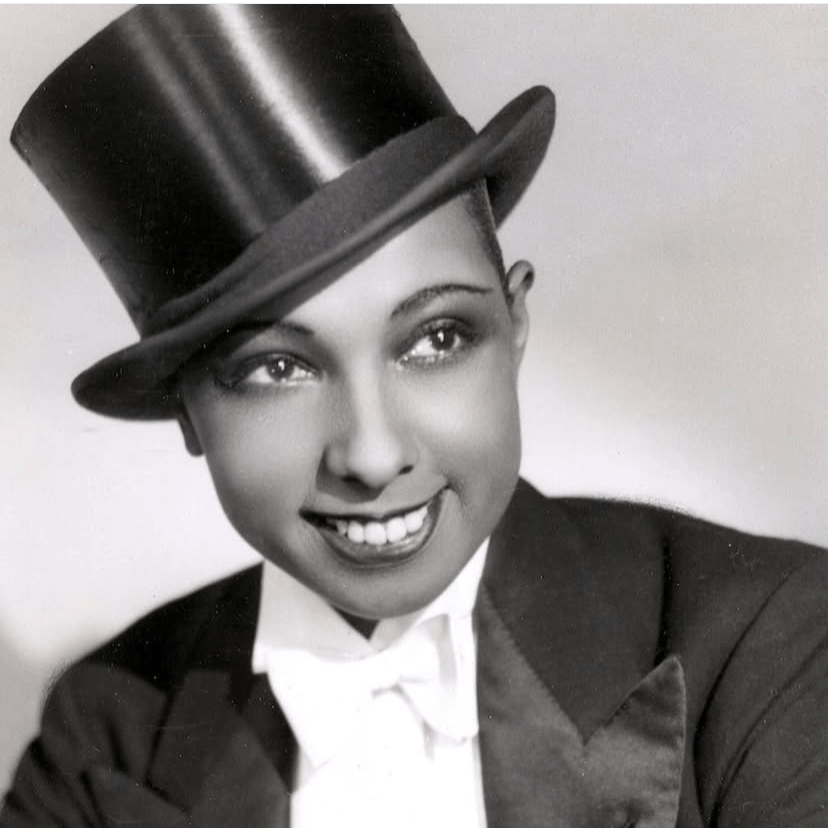
American performer and activist Josephine Baker was BOTD in 1906. Raised in squalid poverty, she joined a dance troupe in her teens, and travelled to Paris in 1925, settling there and becoming a cabaret star at the Folies Bergére. She caused a sensation with her erotic “Danse Sauvage”, performed wearing only a skirt of artificial bananas and a necklace. Dubbed the “Black Venus”, Baker became a symbol of the sexually liberated Jazz Age, with celebrity fans including Ernest Hemingway, Pablo Picasso and Jean Cocteau. She is also thought to have had an affair with the writer Colette and the painter Frida Kahlo. She became a popular singer and recording artist in the 1930s, developing a devoted fanbase in France and Western Europe. During the Second World War, she worked for the French Resistance, often at great personal risk. After the war, she was awarded the Legion d’Honneur by President Charles de Gaulle for her service. During the 1950s and 1960s, she returned frequently to perform in the United States, becoming an emerging figure in the emerging Black civil rights movement. Refusing to perform at segregated venues, she famously made a citizen’s arrest in 1951 after a white man objected to her eating in a restaurant. She appeared at the 1963 March on Washington alongside Martin Luther King Jr and Bayard Rustin, and was the only woman invited to speak at the event. Married and divorced four times, she adopted a menagerie of ten children, requiring her to perform and tour continuously to support them. After years of ill health and financial troubles, she made a triumphant comeback in the mid 1970s with a series of retrospective concerts. She died in 1975, aged 68, surrounded by glowing reviews of her final performance. In 2021, her body was interred in the Panthèon in Paris, the first Black woman to be so honoured. She has been portrayed numerous times on stage and screen, notably by Diana Ross in a 1970s Broadway show and TV film and by Lynn Whitfield in the 1991 TV biopic The Josephine Baker Story. Her life, work and legacy has been extensively discussed by queer historians, notably for the intersections between her race, gender and ethnicity and the degree to which she controlled her image as a sexually “exotic” Black woman. She will be played by Janelle Monáe in the forthcoming TV biopic De La Resistance.
Josephine Baker

 Super Gays Born on this Day