
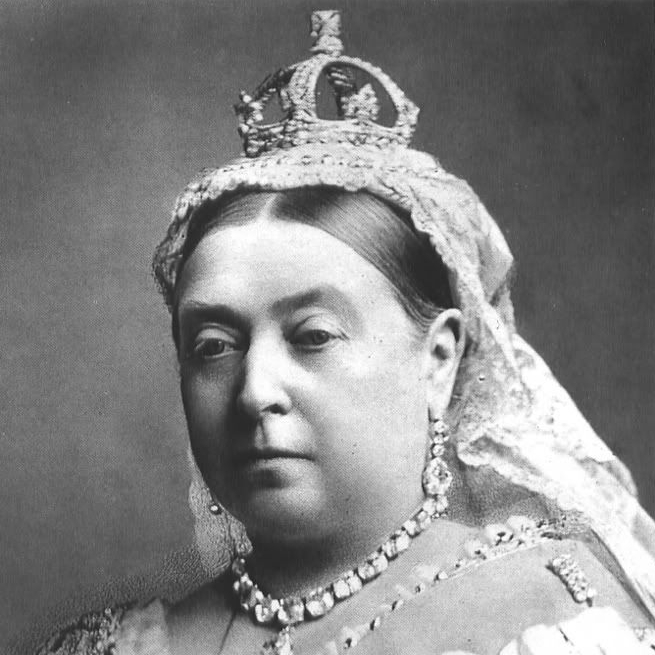
English monarch Queen Victoria of Great Britain was BOTD in 1819. Born in London, she was the only child of the Duke of Kent, the fourth son of King George III. Following the deaths of her grandfather and father and the lack of other legitimate successors, she was identified as the heir presumptive in 1830. Her teens were spent under the supervision of an ambitious guardian Sir John Conroy, who restricted her social interactions and pressured her (unsuccessfully) to appoint him as her private secretary. She became Queen in 1837, aged 18, and promptly banished Conroy from court, relying instead on the advice of her first Prime Minister, Lord Melbourne. She ruled for 63 years, becoming the emblem of the Victorian era, a period of great economic prosperity and industrial advancement, including the colonisation of nearly a fifth of the world’s population. In 1840, she married her cousin Prince Albert of Saxe-Coburg and Gotha, with whom she had an unusually amorous relationship, producing nine children who were married off to royal families throughout Europe. Her reign was a synonymous with strict moral standards, with the Royal family presenting an idealised version of bourgeois domesticity. Under her rule, the death penalty was abolished for sodomy, replaced in 1885 by the wider offence of “gross indecency” which punished all sexual interactions between men with imprisonment and hard labour. A popular (though now debunked) myth held that Victoria refused to approve a bill that would also criminalise lesbianism, claiming that “women do not do such things”. The Victorian anti-gay laws remained in force in England until 1967, resulting in the persecution of Oscar Wilde, Alan Turing, John Gielgud, Lord Montagu, Peter Wildeblood and over 49,000 other men. Britain also exported its penal code to its colonies around the world, making homosexuality a criminal offence across the Empire, in many cases overruling indigenous laws that were more tolerant of sexual difference. Of the 72 countries where homosexuality is still a criminal offence, over half are former British territories. Victoria died in 1901, signalling the end of a near-century of British economic and political domination. She has been played numerous times onscreen, notably by Judi Dench in the films Mrs Brown and Victoria & Abdul, by Emily Blunt in The Young Victoria and perhaps most successfully by Miriam Margolyes in Blackadder’s Christmas Carol.
Queen Victoria

 Super Gays Born on this Day