
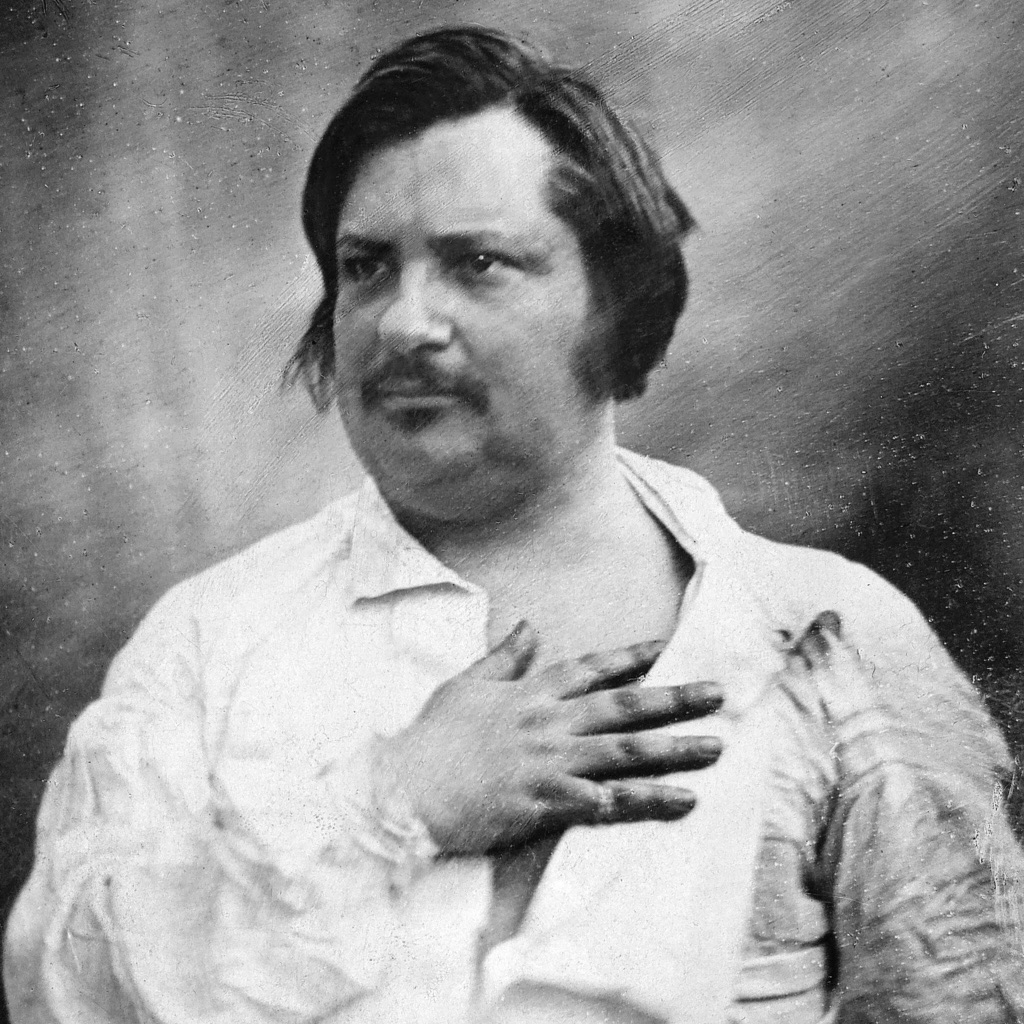
French writer Honoré de Balzac was BOTD in 1799. Born in Tours to a bourgeois family, he was sent to school in Vendôme. His family moved to Paris in 1814, where he studied at the Sorbonne, followed by three unhappy years as a lawyer’s clerk. After an unsuccessful attempt at playwriting, he tried various careers as a printer, publisher and typefoundry manager, amassing substantial debts and narrowly avoiding bankruptcy. He finally achieved literary success in the 1820s with the novel Les Chouans, the satirical essay La Physiologie du Marriage (The Physiology of Marriage) and the story collection Scènes de la vie privée (Scenes from Private Life). A prolific writer, he wrote up to 15 hours a day, while maintaining an active social life, frequenting literary salons and affecting an aristocratic background by adding “de” to his surname. He is best known for La Comédie Humaine (The Human Comedy), a series of 90 interlinked novels, stories and essays written between 1829 and 1848, presenting a panorama of post-Napoleonic French society. Praised for his lively narrative style, complex psychological portraits, and encyclopaedic analysis of high and low social spheres, he became a major influence on the development of the realist novel. Three of his most popular novels – Le Père Goriot (Father Goriot), Splendeurs et misères des courtisanes (The Splendours and Miseries of Courtesans) and Illusions perdues (Lost Illusions) – feature a charismatic villain named Vautrin who pursues a number of young men, eventually forming a relationship with the handsome Lucien de Rubempré. Despite being a central part of Balzac’s narrative, Vautrin’s homosexuality was largely ignored by critics until the 1970s, and is now considered one of Western literature’s first clearly-identified gay characters. Balzac died in 1850 aged 51, just five months after his marriage to Polish noblewoman Ewelina Hańska. Now regarded as a master of French literature, La Comédie Humaine has remained permanently in print and has been adapted frequently for the stage and screen.
Honoré de Balzac

 Super Gays Born on this Day