
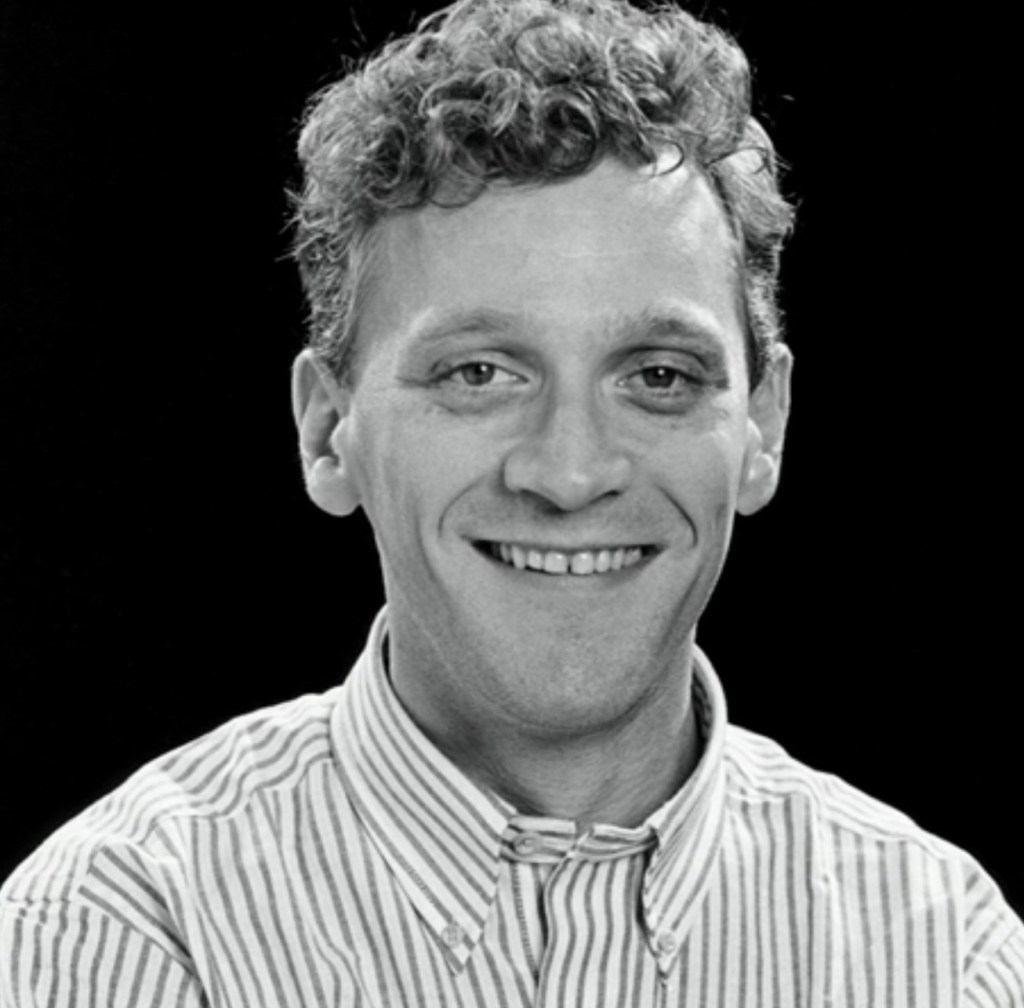
American playwright and songwriter Howard Ashman was BOTD in 1950. Born in Baltimore, Maryland, he developed an early interest in theatre. He studied drama at Boston University before completing post-graduate study at Indiana University, where he met his first boyfriend Stuart White. They moved to New York City in 1974, where Ashman worked as an editor, writing and producing plays in his spare time. In 1977, he joined the BMI Workshop, where he met and began collaborating with songwriter Alan Menken. Their first musical, Kurt Vonnegut’s God Bless You, Mr Rosewater, was produced in 1979. Their breakthrough came with their 1982 musical adaptation of the comedy-horror film Little Shop of Horrors, which ran off-Broadway for five years, followed by a successful London transfer. It was adapted into a musical film in 1986 with original songs by Ashman and Menken, earning them an Oscar nomination. They achieved global success for 1989 Disney musical film The Little Mermaid, loosely based on Hans Christian Andersen‘s fairy tale. Considered a risk at the time, as Disney’s first fairy tale adaptation in 30 years, it was a box office hit, earning US$235 million and winning Oscars for Ashman and Menken’s score and original songs. In 1988, Ashman was diagnosed with HIV, which rapidly progressed to full-blown AIDS. He and Menken continued working on their next project for Disney, a musical version of Aladdin. Released in 1992, it surpassed Mermaid‘s success with box office earnings of US$504 million, again winning Oscars for their score and original song. While working on Aladdin, the pair were invited to resuscitate Disney’s stalled film of Beauty and the Beast and convert it into a musical. The pre-production team was moved from London to New York to allow Ashman to work on the project while receiving medical treatment. He died of complications from AIDS in 1991, aged 40, survived by his long-term partner Bill Lauch. Beauty and the Beast was released six months later, and dedicated to Ashman. A critical and commercial juggernaut, it earned US$451 million at the box office and was nominated for six Oscars (including three for Menken and Ashman’s songs) and became the first animated film nominated for Best Picture. Menken and Lauch accepted the award for Best Original Song, dedicating their win to Ashman. Now considered one of Hollywood’s greatest lyricists, Ashman is widely credited for launching the “Disney Renaissance” of animated movie musicals. Critics and film historians have also noted the queer resonances in his work, notably Ursula, the villainous sea-witch of Mermaid, being based on drag queen Divine, and the influence of queer filmmaker Jean Cocteau on Beauty and the Beast.
Howard Ashman

 Super Gays Born on this Day