
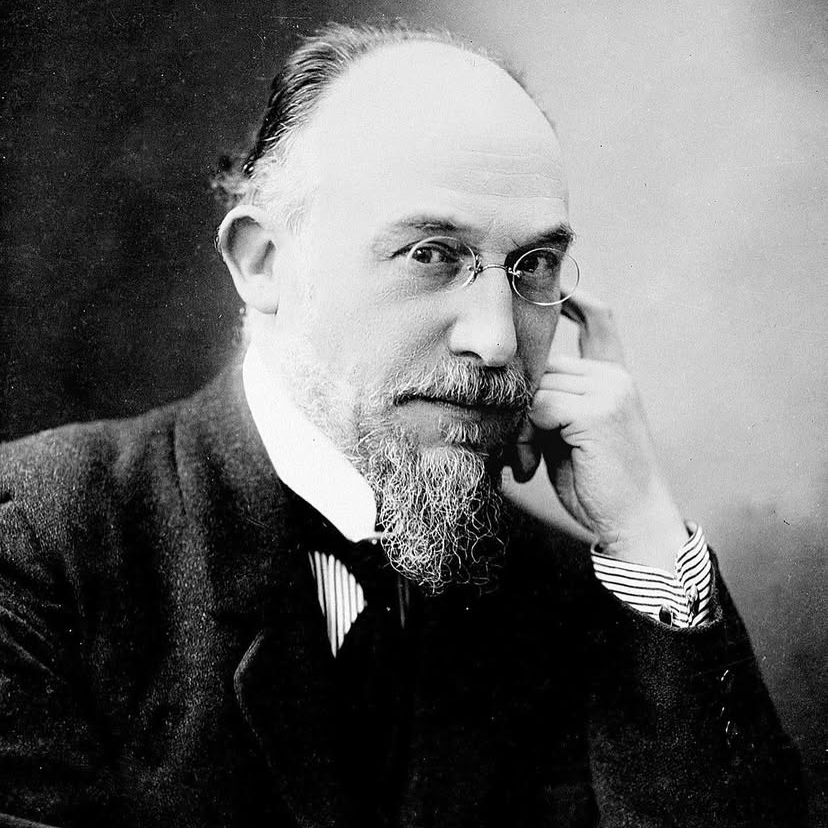
French composer Erik Satie was BOTD in 1866. Born in Honfleur, Calvados, he studied music at the Conservatoire de Paris, dropping out to become a pianist at a cabaret in Montmartre and began composing works for solo piano. He also wrote music for a Rosicrucian sect to which he was briefly attached. He also became associated with the Rosicrucian movement and wrote several works under its influence, notably the Messe des pauvres (Mass of the Poor). His piano compositions, notably the Gymnopédies and Gnossiennes, represented a break from 19th century Romanticism, notable for their spare unsentimental style, flirtation with dissonance and disregard for traditional musical notation. He had a combative friendship with fellow composer Claude Debussy, who outranked him in popularity and whom Satie often mocked in his own work. He adopted an eccentric personality to match his compositions, living alone in suburban Paris, dressing as a priest and refusing to let others enter his home. A meeting with Jean Cocteau led to his being commissioned by Sergei Diaghilev to write the music for the 1917 ballet Parade, with choreography by Léonide Massine and sets by Pablo Picasso from a scenario by Cocteau. Satie’s innovative score incorporated typewriters, sirens, airplane propellers, ticker tape, and a lottery wheel, and became a formative work in the Surrealist movement. Its success led to his being championed by younger composers including Igor Stravinsky, Francis Poulenc and Maurice Ravel, and he began receiving commissions, improving his financial situation. His later compositions included the chamber piece Socrate, the ballet Relâche and the Nocturnes for solo piano. He also replaced his clerical garb with a series of identically-coloured velvet suits, accessorised with a bowler hat and umbrella. Satie’s only known relationship was a five-month affair with painter Suzanne Valadon, though his eccentric lifestyle and many homosexual friends has led to speculation that he was gay or bisexual. After years of heavy drinking, he died in 1925 of liver cirrhosis, aged 59.
Erik Satie

 Super Gays Born on this Day