
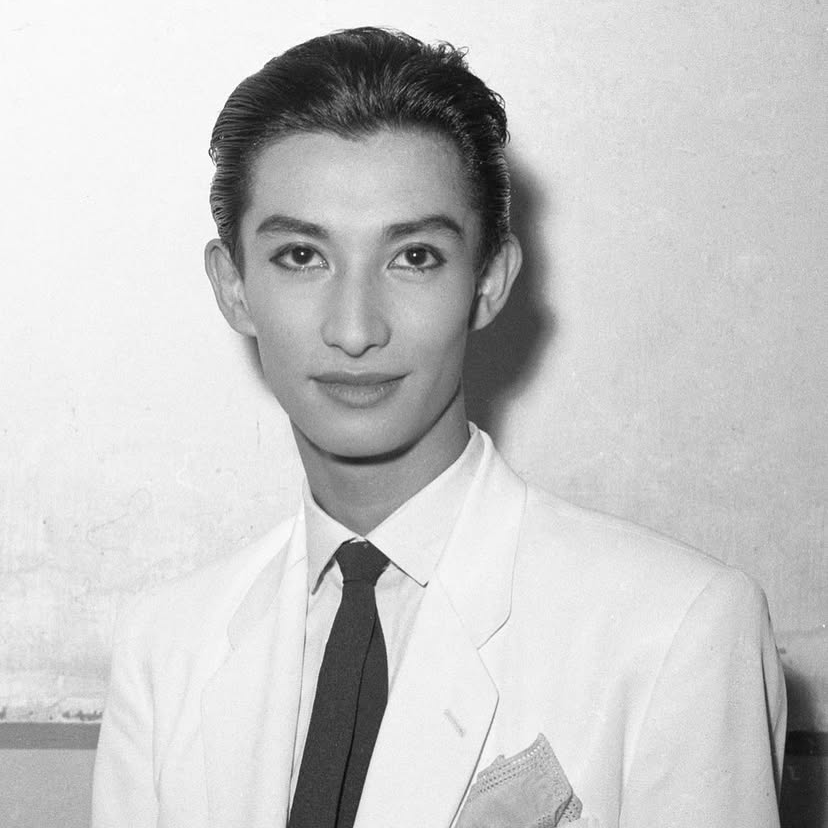
Japanese performer, singer-writer and director Akihiro Miwa was BOTD in 1935. Born Shingo Maruyama in Nagasaki, he was ten when the United States Army Air Force dropped an atomic bomb on the city in 1945, exploding a few kilometers from his home. He survived the attack, though lost his hair and suffered from anaemia and recurring health problems throughout his life. He studied at the Kunitachi College of Music, dropping out to pursue a professional career. He moved to Tokyo in 1952, supporting himself as a waiter, bartender and sex worker, and began singing in cabarets in Tokyo’s red light district, dressed as an androgyne and performing Édith Piaf ballads. Celebrated for his feminine-like beauty, and dubbed “sister boy” in the press, he had a hit with a 1957 Japanese-language cover of Charles Aznavour’s song Me qué, me qué. In 1964, his self-penned song Yoitomake no Uta, a ballad inspired by his performance in a mining town, was banned by commercial broadcasters for its “insensitive” language. He came out publicly as gay in the 1960s, becoming one of Japan’s first openly queer celebrities. His public profile was boosted by appearances in the films Fūryū Kokkei-tan: Sennin Buraku, Aomori-ken no Semushi Otoko and Kuro Bara no Yakata (Black Rose Msnsion). The writer Yukio Mishima praised his “beauty of the heavenly world”, casting him in a female role in a 1968 film adaptation of his play Kurotokage (Black Lizard). Highly controversial on its release, the film’s notoriety led to Miwa being attacked in public. In the 1970s, he launched his cabaret show Akihiro Miwa no Sekai (the World of Akihiro Miwa), touring it for the next 30 years through Asia and Western Europe. In the 2000s, he had a career renaissance as a voice actor in Hayao Miyazaki’s animated films Princess Mononoke and Howl’s Moving Castle, and in Takeshi Kitano’s Takeshi’, and co-hosted the popular TV talk show Ōra no izumi (The spring of aura). In 2018, he was named Man of the Year and given a lifetime achievement award by GQ Japan magazine. The following year, he directed the play Fur no Marie in Tokyo, and was made an honorary citizen of the city in recognition of his life and career.
Akihiro Miwa

 Super Gays Born on this Day