
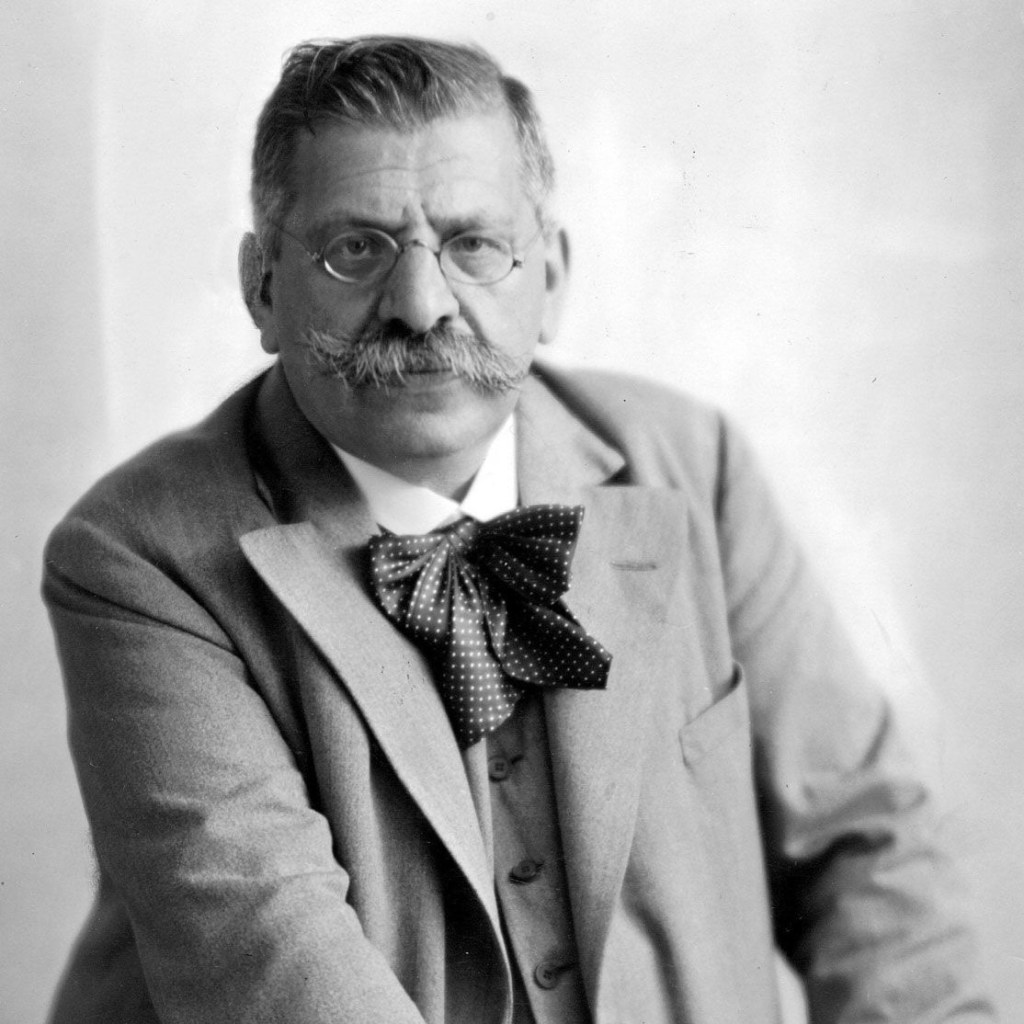
German sexologist and social reformer Magnus Hirschfeld was BOTD in 1868. Born in Kolberg in Prussia (now modern-day Poland) to a middle-class Jewish family, he studied modern languages before transferring to the Kaiser-Wilhelm-Universität in Strasbourg to study medicine. He received his medical degree in 1892, and spent two years travelling through Europe, North Africa and the United States. On a visit to Chicago, he became fascinated by the city’s gay sub-culture, which began his clinical and anthropological interest in homosexuality. He returned to Germany and established a medical practice in Magdeburg, and was deeply affected by the suicide of his gay clients. He relocated to Berlin in 1896, publishing pamphlets and books on sexuality. In his landmark text Die Homosexualität des Mannes und des Weibes (Homosexuality in Men and Women), he argued that homosexuality was a natural biological condition occurring in all cultures and should not be criminalised. Rejecting the then-fashionable theory of a”third sex”, he identified naturally occurring variations within human sexuality, including hermaphrodism and transvestism. In 1897, he co-founded the Wissenschaftlich-humanitäres Komitee (Scientific-Humanitarian Committee), with the goal of amending Germany’s penal code to decriminalise homosexuality. He was instrumental in halting police arrests of queer and trans people, helping instigate an identity card system to prevent trans people being misidentified and harassed. In 1919, he opened the Institut für Sexualwissenschaft (Institute for Sex Research). Thought to be the world’s first sexology institute, it housed Hirschfeld’s vast research library, provided medical treatment and accommodation for queer people and public educational resources on sexuality. Hirschfeld also lived on the second floor, with his partner Karl Giese. The Institute quickly became a haven for Berlin’s LGBTQ population: Hirschfeld and his team treated a number of trans patients, notably Dora Richter, while attracting celebrity visitors including Christopher Isherwood, W. H. Auden, André Gide, Sergei Eisenstein and Walter Benjamin. With the rise of the Nazi Party in Germany, Hirschfeld and the Institute came under frequent attack. In 1930 he undertook a two-year international lecture tour, including a visit to Shanghai, where he began a relationship with 23 year-old sexologist Li Shiu Tong. In 1933, four months after Hitler was appointed Chancellor, the Institute was raided by stormtroopers and the research library was destroyed. Hirschfeld’s citizenship was later revoked, and he never returned to Germany. He moved to Paris, living in a ménage à trois with Giese and Li, later settling in Nice. He died in 1935, on his 67th birthday. Now considered a pioneer of sexology, his work inspired gay liberation movements around the world, notably the Mattachine Society in the United States. In 1982, the Magnus-Hirschfeld-Gesellschaft (Magnus Hirschfeld Society) was established in West Berlin to preserve Hirschfeld’s archives and cultural legacy. He has been portrayed numerous times on screen, notably by Friedel von Wangenheim in Rosa von Praunheim‘s biopic Der Einstein des Sex (The Einstein of Sex) and Bradley Whitford in Joey Soloway‘s TV series Transparent. Hirschfeld appears as a sympathetic doctor in the 1919 film Anders als die Andern (Different From the Others), thought to be the first feature-length film addressing male homosexuality.
Magnus Hirschfeld

 Super Gays Born on this Day