
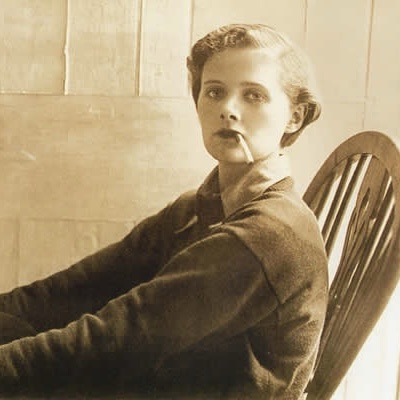
English novelist and playwright Daphne du Maurier was BOTD in 1907. Born in London to a prominent theatrical family, she grew up among London’s theatrical elite, developing a childhood crush on the actress Tallulah Bankhead. A tomboy in her youth, she saw herself as a “half-breed”, female on the outside “with a boy’s mind and a boy’s heart” and created a male persona named Eric Avon. She began writing in her teens, publishing stories in her uncle’s magazine Bystander, and releasing her first novel in 1931. She rose to public attention with her 1936 novel Jamaica Inn, a thriller about smugglers in 19th century Cornwall, filmed in 1939 by Alfred Hitchcock and starring Charles Laughton. She became internationally famous with her 1938 novel Rebecca, a Gothic thriller set in Cornwall about a naïve young bride who is terrorised by the memory of her husband’s first wife. An immediate bestseller, it sold three million copies, won the US National Book Award for favourite novel of the year and was successfully filmed by Hitchcock in 1940. Further success followed with Frenchman’s Creek and My Cousin Rachel, also adapted into films. Her short story The Birds was her third work to be adapted by Hitchcock, becoming the phenomenally successful 1963 horror film of the same name. Don’t Look Now, an alarming story of a married couple haunted by the ghost of their daughter, became a cult success for director Nicholas Roeg in 1977. Despite her success and book sales, du Maurier resented her categorisation as a “mystery writer”, and longed for highbrow literary recognition. She developed a second career as a playwright, including a successful stage adaptation of Rebecca and the West End hits The Years Between and September Tide. She also wrote a biography of her father and a non-fiction historical study of her Huguenot ancestors. Du Maurier had a complex and often conflicted understanding of her gender and sexual identity for much of her life. After a lesbian affair with her French teacher when she was 18, she buried her “Venetian tendencies” and “went to Cairo” (her family’s slang for heterosexual sex), having an affair with the (male) film director Carol Reed. She married Major Frederick “Boy” Browning in 1932, having three children together. The marriage deteriorated following his return from the Second World War, and they pursued separate lives for the next 20 years. In 1947, du Maurier fell passionately in love with Ellen Doubleday, the wife of her US publisher, and later had an affair with actress Gertrude Lawrence, the star of September Tide. Appointed a Dame of the British Empire in 1969, she became increasingly reclusive, retreating to her house in Cornwall. Later in life, she published a memoir, Growing Pains, and a literary reminiscence, The Rebecca Notebook and Other Memories. She died in 1989, aged 81. Still one of the best-selling authors of all time, her novels have remained continuously in print. Admired for her expert handling of suspense and vivid descriptions of the Cornish landscape, her work has been reappraised by feminist and queer critics for her intense explorations of female and lesbian sexuality and subversions of gender norms. Mrs Danvers, the obsessive housekeeper of Rebecca, has become a lesbian icon, vividly portrayed by Judith Anderson in Hitchcock’s film. Du Maurier’s life-long belief in her “male energy” has also led to speculation that she may have been transgender. She was portrayed by Geraldine Somerville in the 2007 TV film Daphne, focusing on her relationship with Lawrence.
Daphne du Maurier

 Super Gays Born on this Day