
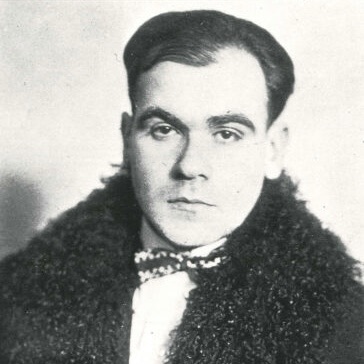
Italian painter and poet Filippo De Pisis was BOTD in 1896. Born Luigi Filippo Tibertelli in Ferrara into a wealthy aristocratic family, he was privately educated, and began painting lessons aged eight. Exempted from military service due to his nerves, he studied literature and philosophy at the University of Bologna, and showed his first exhibition of paintings. He moved to Rome in 1919, publishing a collection of his writings La città dalle 100 meraviglie and a volume of poetry, La lampada, in 1920. He taught art at a high school, recording sexual fantasies about his male students in his diaries, and cruised oarsman on the Tiber in his spare time. In 1924, he moved to Paris, socialising with Henri Matisse, Pablo Picasso, Georges Braque, Jean Cocteau and James Joyce, exploring the city’s gay underworld and acquiring pretty young men to sketch nude. He returned to Italy at the outbreak of World War Two, where he was kept under surveillance by the Fascist government, eventually settling in Venice. He cultivated the life of an eccentric, keeping a pet parrot, travelling in his own gondola with uniformed gondoliers and hosting orgiastic male-only midnight parties. In 1948, he exhibited at the Venice Biennale, where his Post-Impressionist inspired still lives and maritime scenes were critically acclaimed. He was denied the Biennale’s main prize, supposedly due to concerns over his homosexuality. By the 1950s, he was regarded as one of Italy’s most important painters, winning the Premio Fiorino and the Mazotta Prize. In his later years he suffered from a neurological disorder, eventually retiring to a nursing home in Brugherio, where he died in 1956. His paintings are in the collections of the Museum of Modern Art, the Peggy Guggenheim Collection, the Palazzo Ruspoli and the Museo Filippo de Pisis in Ferrara.
Filippo De Pisis

 Super Gays Born on this Day